Teach the Game
A script to teach Orloj at the table — how you win, the boards, a turn, the end, every way to score and what each resource is for.
How you win
“Prague, 1865. We each run a clockmaker’s workshop helping to finish the Old Town’s astronomical clock. We build the month and zodiac dials of its calendar and carve its twelve apostles. The most victory points at the end wins.”
You need victory points. The big sources are:
- Constructing dials — paying resources and joining your dials into connected groups;
- Apostles — full rows of your apostle panel;
- End-of-game bonuses — stained-glass windows, common objectives, assistants and gold.
To get there you need resources (paint, wood, iron, gold, coins) and workers, and the mastery levels that make the clock work harder for you. Everything is reached by turning the clock: where its hand points is what you can do.
The boards
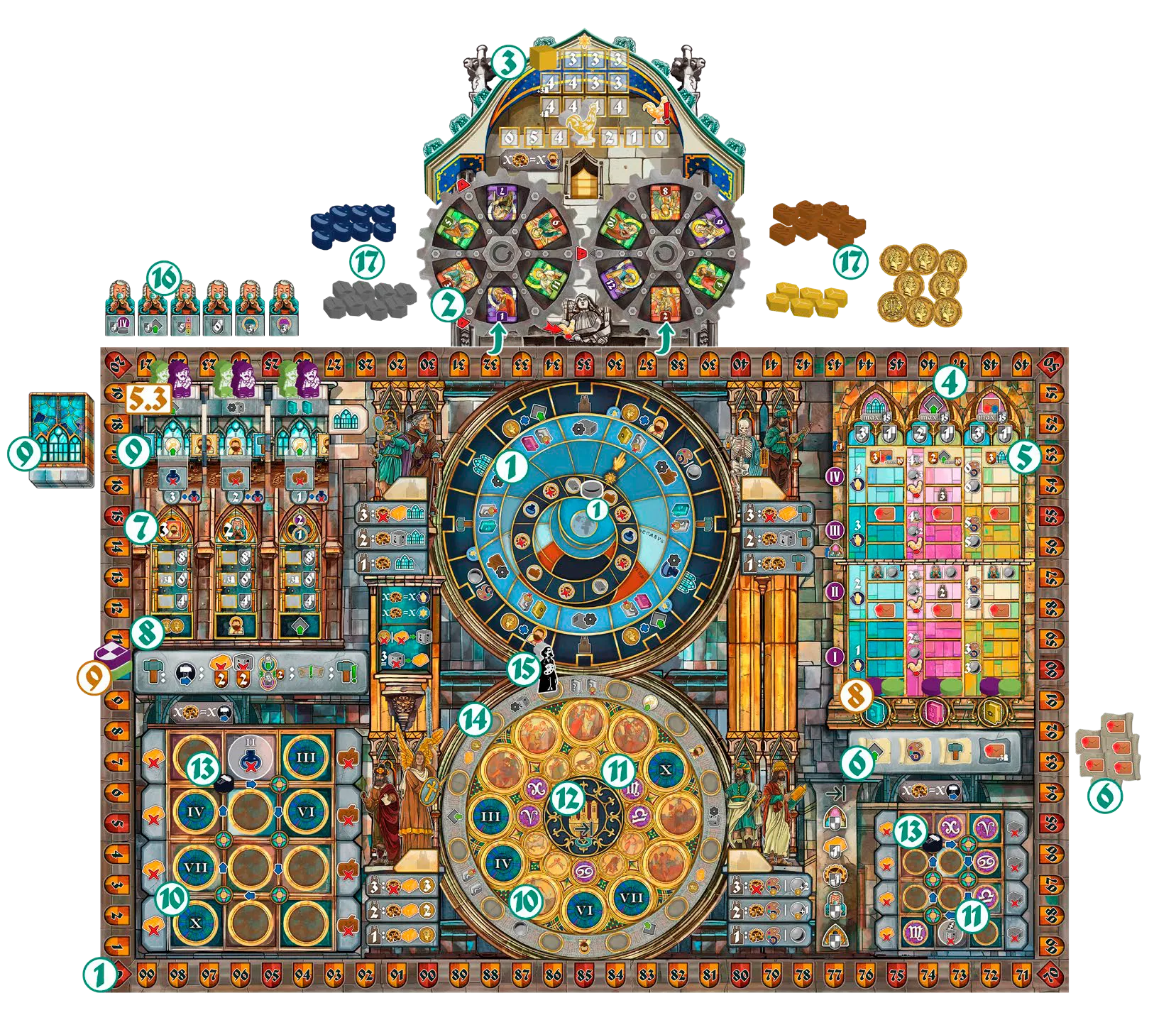
- The clock — three rings. The outer ring never moves; the clock face turns counterclockwise; the astronomical dial with the hand turns clockwise and carries the moon. The hand points at one outer-ring section and one clock-face section: your two actions.
- The calendar — the month and zodiac dials you build, with the painter moving round it.
- The walk of the apostles — the gears that bring apostles down, and the golden rooster above.
- Mastery tracks — blue (how far you turn the dial free), pink (workers back when passing, sculptor level), yellow (painter and moon distance).
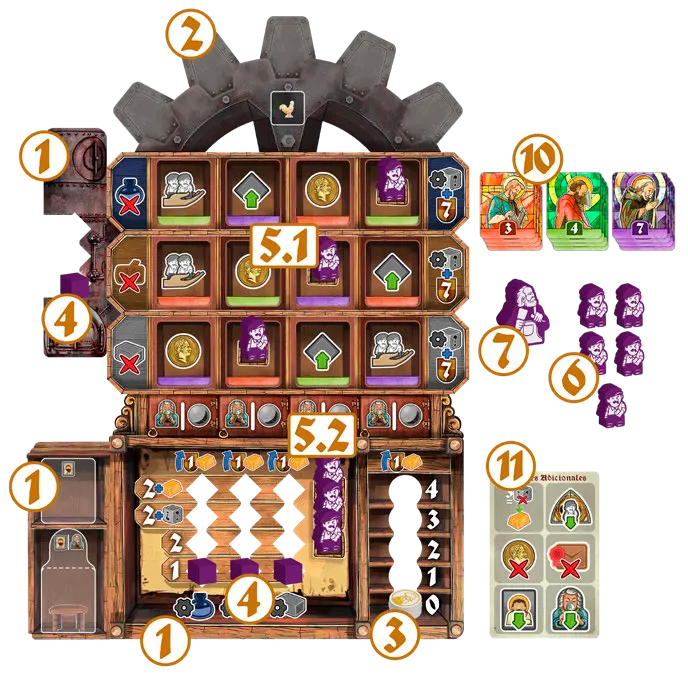
Your personal board holds the apostle panel, the production tracks (paint, wood, iron) with the workers they unlock, and the warehouse for apostles and assistants waiting to be placed.
A turn
Play goes clockwise, one turn each, no phases. On your turn do one of:
- Activate the clock — turn the astronomical dial at least 1 space (further than your blue level costs deviations), optionally turn the clock face (every space costs a deviation), place a worker where the hand points and take both sections’ actions.
- Pass — take back up to your pink level in workers, activate the moon, move the rooster.
At any time you may also take additional actions: place apostles and assistants, use scrolls, spend coins, claim objectives, trade 3 identical resources for 1 gold.
Deviation is borrowing: force the mechanism now, and every broken gear still showing costs 1 VP at each rooster’s call and at the end. The moon repairs them.
How the game ends
The game ends after the round in which the last calendar dial is built or the fourth rooster’s call happens, whichever comes first. Finish the round so everyone has had the same number of turns, then score the end-game bonuses. Most VPs wins; ties go to the most apostles on the panel.
The rooster’s call happens when the golden rooster reaches the end of its track (it moves when someone passes or when a red tooth of the apostle gear lines up with the arrow): everyone repairs deviations as their rooster track allows, then loses 1 VP per broken gear left.
Ways to score
| Points | How and when |
|---|---|
| Construct a dial | 2 VP per resource paid + 2 VP per dial in your connected group, at once. |
| Final construction | After the last dial is built: pay 1 gold, wood, paint and iron for 8 VP. |
| Apostle panel rows | 7 VP and a production for each full row. |
| Royal scrolls | The first to reach one on a mastery track scores its condition (max 10 VP). |
| Mastery, upgrade at the top | 1 VP when a track is already full. |
| Mastery windows (end) | Disc on space 7+: primary or secondary value × how often you meet the window (max 15). |
| Common objectives (end) | 8, 6 or 4 VP for your worker on the objective. |
| Assistants (end) | Each assistant on a workshop card scores its condition. |
| Gold (end) | 1 VP per gold, after converting what you can. |
| Losing points | −1 VP per broken gear at each rooster’s call and at the end. |
What each resource is for
| Resource | Why you need it | How you get it | How you use it |
|---|---|---|---|
   Basic resources Basic resources | Pay for dials, workshop cards, apostles. | Production sections, the moon, calendar and hammer bonuses. | Construct (2 VP each), expand the workshop, place apostles; 3 identical → 1 gold. |
 Gold Gold | Wild for any basic resource; 1 VP each at the end. | Top of a production track, trading 3 resources, bonuses. | Pay instead of any basic resource; keep for points. |
 Coins Coins | Wild for any basic resource; extra mastery steps. | Coin sections, apostle bonuses, scrolls. | Pay instead of a basic resource (not gold); 1 coin = extra mastery step. |
 Workers Workers | You can’t activate the clock without one; they also mark your dials and objectives. | Production tracks, apostle panel, first workshop card in a position, passing, apostle bonuses. | Placed on the clock, on dials you build, on objectives. |
 Apostles Apostles | Panel bonuses and 7-VP rows. | Take an apostle (coin + apostle section, scrolls, workshop icons). | Place on your panel (pay the row cost). |
 Assistants Assistants | End-game points. | Mastery bonuses, panel columns. | Place on a workshop card (pay its resource). |
| Scrolls | One-shot extra actions; they count for royal scrolls. | Mastery track bonuses. | Flip for its action at any time. |
 Deviation tokens Deviation tokens | Let you go beyond your limits. | You have 5. | Flip to force; the moon and your rooster track flip them back. |
Teaching tips
- Show the clock first — once players see that the hand picks their two actions, the rest follows.
- Warn about deviations early — they are cheap now and cost points later.
- Two mastery tracks, not three, is the usual advice for a first game.
- More: Tips.