Learn Orloj
Learn the game in 5 short steps. Everything links to the full rules.
Welcome to Orloj
Prague, 1865. The Old Town’s astronomical clock is getting its painted calendar and its parade of apostles, and each of you runs a clockmaker’s workshop helping to finish it. You build the month and zodiac dials of the calendar, carve the twelve apostles, and improve your skills along the way.
The player with the most victory points wins. Points come from three main places:
 Constructing dials — pay resources to build a month or zodiac sign and leave a
worker on it. Connected groups of your dials score more.
Constructing dials — pay resources to build a month or zodiac sign and leave a
worker on it. Connected groups of your dials score more. Your apostle panel — placing apostles gives bonuses, and full rows and columns
give more.
Your apostle panel — placing apostles gives bonuses, and full rows and columns
give more.- End-of-game bonuses — stained-glass windows, common objectives, assistants and leftover gold.
1–4 players (solo against Josef Mánes’ studio), about 60–120 minutes. Ready to set up? Open the setup checklist — it adapts to your player count.
The clock
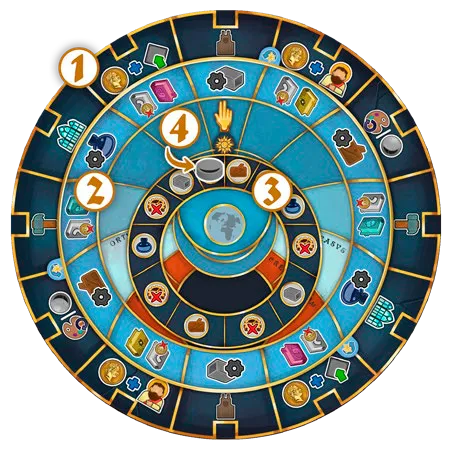
The board’s centre is the clock itself, in three rings:
- the outer ring, printed on the board, never moves;
- the clock face turns only counterclockwise;
- the astronomical dial turns only clockwise and carries the hand and the
 moon.
moon.
On your turn you turn the dials, and wherever the hand ends up pointing — one section of the outer ring and one of the clock face — are the actions you get.
How far you can go depends on your three mastery tracks:
- blue — how far you can turn the astronomical dial for free;
- pink — how many workers you get back when you pass, and how good your sculptor is;
- yellow — how far the painter walks and how many steps the moon takes.
More detail: Activating the clock.
Your turn
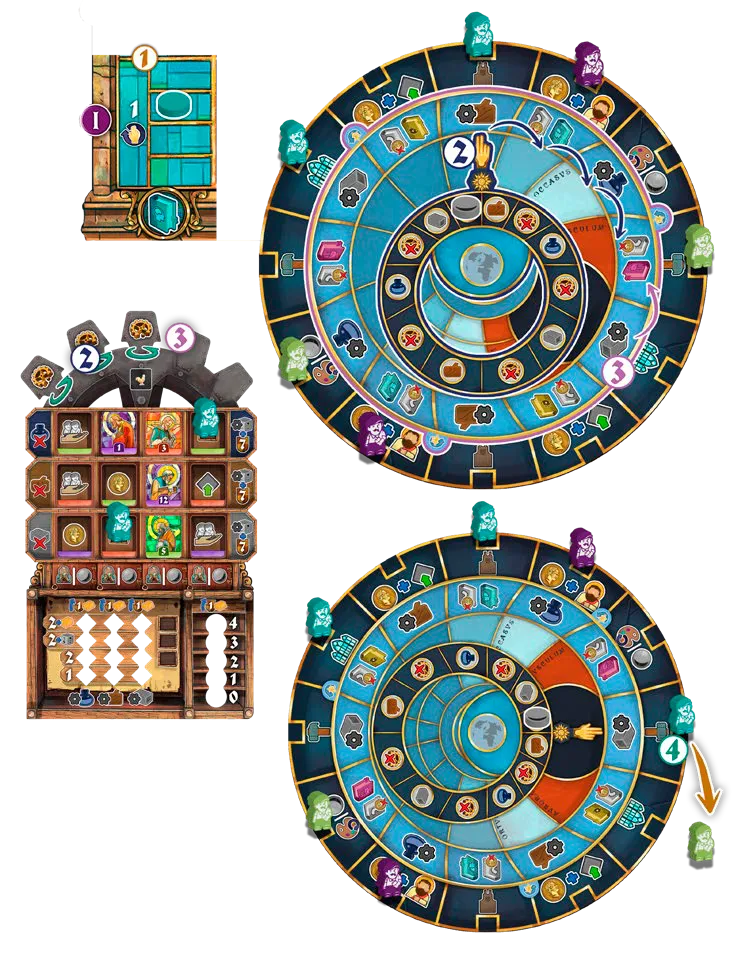
Each turn you do one of two things.
Activate the clock. Turn the astronomical dial at least one space, optionally turn the clock
face, place a  worker where the hand points, and take the two sections’ actions in the
order you like.
worker where the hand points, and take the two sections’ actions in the
order you like.
Pass. Take back some workers (up to your pink level), activate the moon and move the golden rooster one space.
Whatever you choose, you can also take additional actions at any time — place apostles, use scrolls, claim objectives, trade for gold.
Need to go further than your skills allow? Force a deviation  : flip one of your
five gear tokens to push the mechanism. It costs points at every rooster’s call unless you fix it
first — the moon is the best repair tool.
: flip one of your
five gear tokens to push the mechanism. It costs points at every rooster’s call unless you fix it
first — the moon is the best repair tool.
First actions
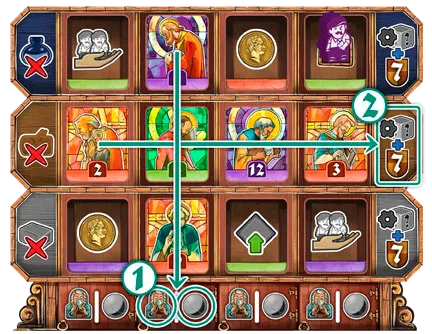
Early on, build the engine that will pay for your constructions later:
- Take apostles and place them on your panel. Each placement gives a bonus and some free workers.
- Upgrade production so each production action brings more


 , and unlocks workers when all three cubes line up.
 - Expand your workshop — the first card in each position frees another worker.
- Pick two mastery tracks and push them; spreading over all three is rarely worth it.
- Look at the calendar bonus you want before choosing which dial to build, and keep an eye on the three common objectives — the first to claim each gets an extra bonus.
Scoring and game end
The game ends after the round in which the last calendar dial is built, or after the round of the fourth rooster’s call — whichever comes first. Everyone finishes the round.
You score many points during play: resources spent on constructions, connected dials, apostle rows, royal scrolls. At the end you add:
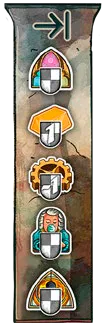
- the three mastery stained-glass windows (only if your disc reached space 7 on that track),
- 1 VP per gold after converting leftovers,
- minus 1 VP per broken gear still showing,
- your assistants on workshop cards,
- 8 / 6 / 4 VP for your places on the common objectives.
Ties go to the player with the most apostles placed. The full list is in Endgame scoring; the community’s rulings are in the FAQ.