Solo Mode
Play against Josef Mánes' studio — setup changes, his turn, scoring and difficulty levels.
Overview
In the solo game you compete with the studio of Josef Mánes, the painter of the Orloj calendar. He follows a deck of action cards instead of making choices. He gets 12 turns; after his twelfth you both score, and you win only by beating his score — a tie goes to him.
Setup changes
Use the normal setup with these changes. The setup checklist does them for you when you choose Solo.
- Crowning piece — use the solo one. Round marker and rooster both start on 4. After every rooster’s call the rooster goes back to 4; the round marker never moves.
- Removed components — before dealing them, take out the three that score upgrades: the upgrade mastery window, the “2 VP per upgrade” royal scroll and the “five upgrades” common objective.
- Calendar — shuffle Josef Mánes’ action cards and reveal 6. The month and zodiac dials on them go straight onto the calendar; blocked dials go on the construction spaces they show; every other dial goes on its construction space plain side up. Set aside the apostles on those 6 cards, then return the 6 cards to the box. The other 12 cards are this game’s deck.
- Apostles — you and Josef Mánes share a single set.
- Production — your production cubes start on the second space of each track (forge cube on the first). That unlocks a sixth worker straight away.
Automa setup
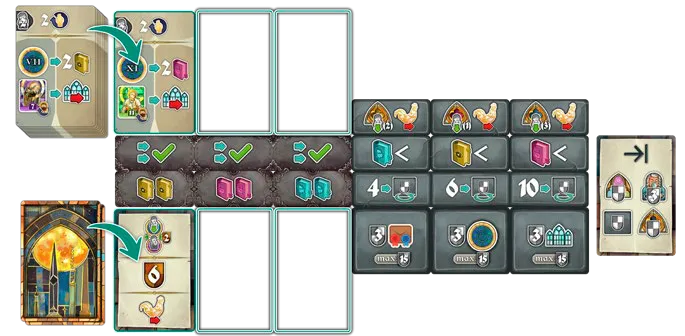
Components with a ★ symbol are the advanced side (see difficulty levels).
- The conditions-met tile in his area, with the mastery-track objective tile to its right.
- The endgame scoring card to the right of his area.
- Shuffle his 3 mastery tiles and reveal one in each position.
- Shuffle the 3 mastery-track tiles and reveal one in each position.
- Shuffle the 3 end-of-round action tiles and reveal one in each position.
- Shuffle his 5 scoring tiles, reveal 3 in their positions and return the rest.
- Lay out his 12 action cards face up.
- Shuffle the 3 basic turn-scoring cards face down.
- He has no personal board, forge, warehouse, deviation tokens or cubes — just his 14 workers as available workers.
- One mastery disc on each track and his scoring marker on 10, as usual.
Solo game flow
You always play first, then Josef Mánes. After his turns 3, 6 and 9 there is a short end-of-round phase. After his 12th turn the game ends.
The automa’s turn
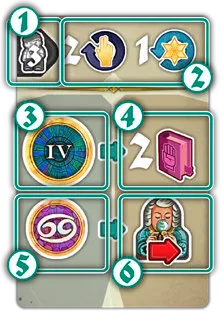
Josef Mánes never takes or spends resources and never forces or corrects deviations. He gets no rewards for workshop cards, constructions, objectives or mastery — except that he takes scrolls and scores royal scrolls when his discs reach them. He ignores the action the hand points at and only does what his card says.
Each action card shows: the workers he needs, how to turn the astronomical dial and the clock face, then a first action with its reward and a second action with its reward. On his turn:
- Workers — if he doesn’t have the workers the card asks for, he recovers all his workers from the clock and his turn ends (then draw his next card and scoring card).
- Clock — turn the dials as shown and place one of his workers on the outer-ring section the hand points at. A worker already there goes back to its owner, as usual.
- First action — do it; if it succeeded, he also takes its reward.
- Second action — the same.
- Action check — see below.
Automa actions
- Construct a dial — put the dial shown on the card straight onto the calendar, plain side up.
- Take an apostle — take the apostle shown from the shared set and turn the gears one step.
- Mastery — move two spaces up the track of that colour. On a scroll space he takes a scroll from the face-down pile; on a royal scroll space he scores it. If he is already at the top, he scores 1 VP per step he would have moved. He never takes assistants or activates the moon from the tracks.
- Take a workshop card — the leftmost or rightmost of the three on the board, as the arrow shows; refill as usual.
- Take an assistant — the leftmost or rightmost available assistant, as the arrow shows.
- Move the painter — the number of spaces shown, clockwise.
Action check
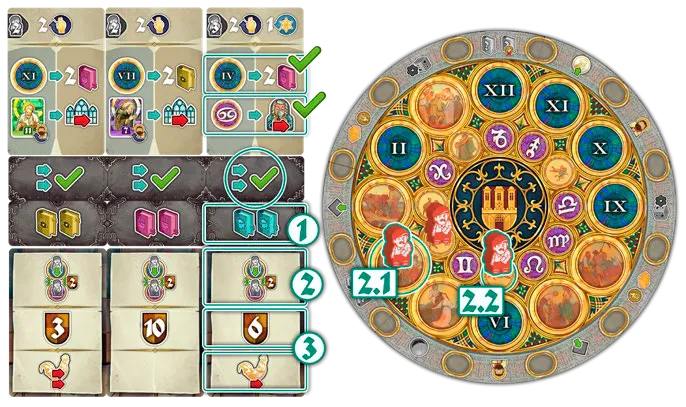
If either action on his card failed, flip back any dial he built this turn and end his turn.
If both succeeded:
- He gains the mastery bonuses shown on his mastery tiles — 2 steps at basic level, 3 at medium and advanced.
- Flip the dials he built to their illustrated side, put one of his workers on each and score 2 VP per dial in his connected group, as in a normal construction. With two constructions, place the top one first.
- Score the turn-scoring card and move the rooster as it shows. If the rooster reaches the end, the rooster’s call happens after his turn — he never loses points from it.
Then draw his next action card and turn-scoring card into the next free positions.
End of rounds 3, 6 and 9
After his turn in rounds 3, 6 and 9:
- Put one of his workers on the first free space of the common objective named on the end-of-round tile (1 = leftmost) — whether or not he meets its condition. If your worker holds the first space, he takes the third. If he has no workers, he first recovers all of his from the clock face.
- Move the rooster one space; do a rooster’s call if needed.
- Check his disc on the track shown by the mastery-track tile: if it is lower than the value on the mastery-track objective tile, flip the matching scoring tile to its 0 VP side.
- Flip the mastery-track tile and the end-of-round tile to the hourglass side.
- Discard the three used action cards, reshuffle the turn-scoring cards and replace the three face-up scrolls on the board with new ones.
End of the game
The game ends right after his 12th turn. You score as usual. He scores, following his endgame card:
- mastery stained-glass windows, as usual;
- 3 VP per assistant in his area (6 VP at advanced level);
- each scoring tile that was not flipped — its condition × value, up to 15 VP per tile;
- common objectives, as usual.
His scoring tiles count months with his worker, zodiac dials with his worker, apostles, scrolls or workshop cards in his area — 3 VP each, up to 15 VP per tile.
Difficulty levels
| Level | Change |
|---|---|
| Basic | Play without any ★ component. |
| Medium, option 1 | Flip the mastery tiles and the mastery-track objective tile to their ★ side. |
| Medium, option 2 | Use the 3 advanced turn-scoring cards and the ★ side of the endgame scoring card. |
| Advanced | Both medium options together. |