Reference
The four powers at a glance, card types, trade prices, round summary and the rules for 2 and 3 players.
The four powers
Starting values, as printed on the Player boards and in the starting components.
| USA | EU | Russia | China | |
|---|---|---|---|---|
Starting money  | 30 | 25 | 15 | 20 |
| Starting Armies | 3 | 2 | 2 | 2 |
Engage tokens  | 3 | 3 | 2 | 2 |
 Energy Energy | 3 | 1 | 5 | 1 |
 Raw Materials Raw Materials | 2 | 1 | 4 | 3 |
 Food Food | 3 | 2 | 2 | 3 |
 Consumer Goods Consumer Goods | 3 | 3 | 1 | 4 |
 Services Services | 4 | 4 | 1 | 1 |
 Diplomacy Diplomacy | 4 | 4 | 3 | 3 |
| Trade Deals (exports / imports) | 2 / 2 | 2 / 2 | 3 / 2 | 3 / 3 |
| Starting Countries | Mexico, Iceland, Iraq, Japan | Canada, Norway, EU Member States, Nigeria, Jordan | Belarus, Armenia, Syria, India | South Africa, Tajikistan, Laos, Pakistan |
| Rulebook abilities | Global Superpower Status; Member of NATO | Member of NATO | Secured Sphere of Influence | Global FDI Network |
Resource values are the starting production levels, which are also where your Resource markers start. Each power’s abilities are explained under Power abilities.
Card types
| Card | What it is |
|---|---|
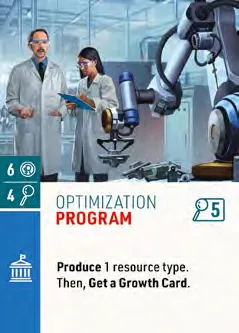 | Ability cards — 12 Starting cards per power, more bought from the Market at Research. Colour = action type; top-left bonus and Research pay out at Research if the card is still in your hand. |
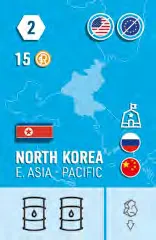 | Country cards — your allies. Value, invest cost, trade symbols, who may build a Base, who may never ally. See Allied Countries. |
 | Strategic Assets — you keep 2 of 5. Each is a powerful one-shot; their VPs set your starting score, and each unused one is worth 2 VPs at the end. |
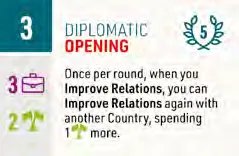 | Growth cards — level, cost, VPs and an ongoing ability that switches on in the round equal to its level. |
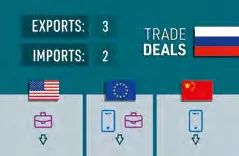 | Trade Deals — your number of Export and Import transactions and what you can buy from each power. |
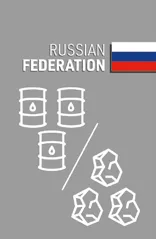 | Commerce cards — resources other players can buy from you; face down once used, face up again when you produce that resource. |
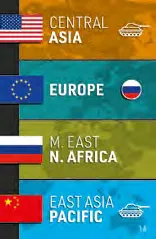 | Auto-Influence cards — 2 and 3 players only: where non-player powers add Influence and Armies, and who they pay. |

Trade prices
| | | | | ||
|---|---|---|---|---|---|---|
| Export (you earn) | 5 | 5 | 5 | 15 | 15 | 20 |
| Import (you pay) | 3 | 3 | 3 | 10 | 10 | — |
Over the storage limit of 10, extra resources become money at the import price; extra Diplomacy is lost.
Round summary
- Preparation (not in round 1): draw 6 · reveal Countries · turn order, fewest VPs picks first · produce primaries · choose Focus.
- Actions: 4 turns each — play a card, a Strategic Asset or pass for 10 · Research (not in round 6) · Auto-Influence (2–3 players).
- Aftermath: FDI income and Engage cash-in · Prosperity · THREAT · Scoring in rounds 3 and 6.
Two and three players
Power choice
With 2 players, one plays the USA or the EU and the other Russia or China. With 3 players, any powers.
Non-player powers
The powers nobody plays still put Influence and Armies on the map through the Auto-Influence cards, and you can still buy from them in Trade (always in stock, paid to the Supply, no Diplomacy bonus). Their Armies don’t count for the Armies Majority token.
Auto-Influence
At setup, draw 2 Auto-Influence cards and put Influence cubes of each unplayed power beside its flag on the cards — and an Army where a row shows one.
At the end of each Action Phase, for each of the 2 cards in turn:
- Place each row’s cube in the Region named on that row — in a free permanent slot if there is one, otherwise in the first free temporary slot. Add the Army of that colour if one is shown.
- If the row also shows the round flag of a power a player controls, that player turns one of
their face-up Commerce cards face down and gains 10 . With no face-up Commerce card,
nothing happens.
Then draw 2 new Auto-Influence cards and load them for next round.
Market and Majorities
- After Research, discard the rightmost Market card with 3 players, the 2 rightmost with 2 players.
- With 2 players, only the winner of each Majority token scores; a tie scores nothing.