Gameplay
Rounds and phases, Preparation, the Action Phase, Research, resources and keywords.
Overview
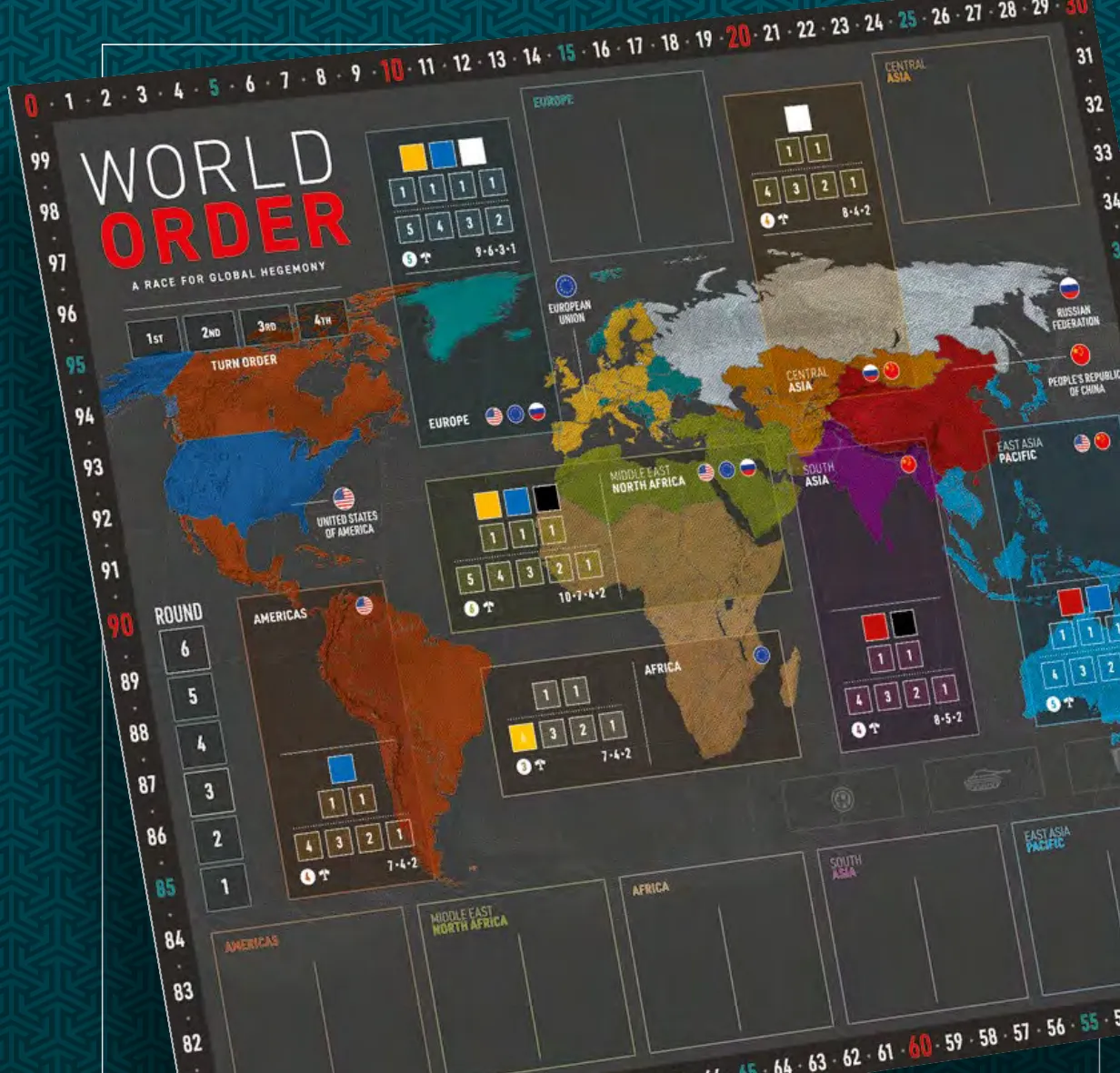
You lead one of four powers of the 2010s — the USA, the EU, Russia or China — and spread Influence across the seven Regions of the map. The game lasts 6 rounds. Placing Influence scores at once, and in rounds 3 and 6 the Regions where you have the most Influence pay bonuses. The player with the most victory points at the end of round 6 wins.
The board
- Regions — seven areas of the map. Each has 2 face-up Country cards, an Engage cost in
 , permanent and temporary Influence slots, and majority bonuses. See
Influence.
, permanent and temporary Influence slots, and majority bonuses. See
Influence. - Zones of interest — a power’s small round flag in a Region puts that Region in its zone of interest. You can always Move Armies there, and rival Armies there can cost you points (see Resolve THREAT).
- Tracks — the VP track around the edge, the Round track and the Turn Order track.
- Majority tokens — most money, most Armies on the map and most allied Countries, scored with the Regions.
Your power
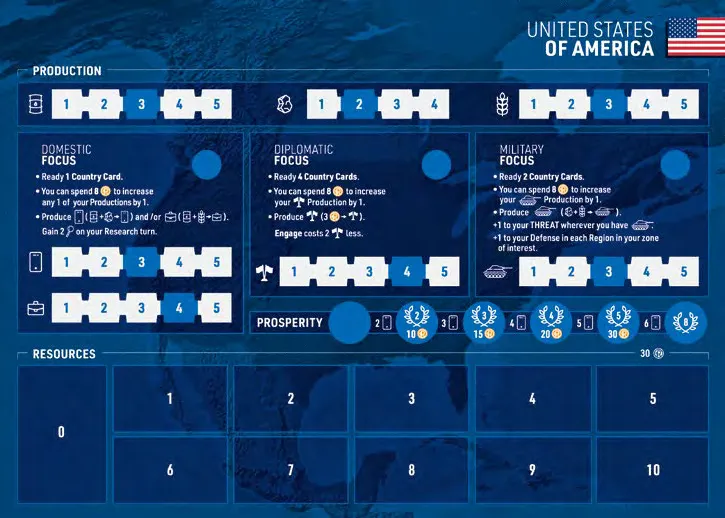
Your Player board shows:
- Production — how much of each resource you make. The top row holds the three primary
resources,
 Energy,
  Raw Materials and
  Food. The tracks under
the Focus boxes hold the secondary ones:
Food. The tracks under
the Focus boxes hold the secondary ones:  Consumer Goods,
  Services,
Diplomacy and Armies.
Services,
Diplomacy and Armies. - Focus — the three options you choose between each round.
- Prosperity — a track you climb by spending Consumer Goods.
- Resources — a track from 0 to 10 where your markers show what you have. Armies are tokens on top of the board instead, and money is coins.
The powers differ: production levels, starting money, allied Countries, Trade Deals and one special scoring ability each (see The four powers).
Game flow
Each round has three phases, in this order:
- Preparation phase — skipped in round 1.
- Action phase — 4 turns each, then Research.
- Aftermath — income, Prosperity, THREAT and, in rounds 3 and 6, scoring.
Preparation phase
Skip this phase in round 1. Most steps can be done by everyone at once; if seeing the others’ choices matters, go in turn order and finish each step before the next.
Draw cards
Draw 6 cards from your deck. If it runs out, shuffle your discard pile into a new deck and keep drawing until you have 6.
Reveal Country cards
In each Region, move the top card of the left Country pile onto the right pile. If that empties the left pile, move the remaining pile to the left and start a new right pile with its top card.
Determine turn order
Slide the Turn Order markers down off the track. The player with the fewest VPs places theirs first, on any free space, then the others in reverse VP order. Ties: least money chooses first, then least starting money.
Produce primary resources
Gain equal to each of your primary production levels.
Choose Focus
Pick Domestic, Diplomatic or Military Focus, move your Focus marker there and carry out its bullet points in order. Each bullet can be used once.
- Ready Countries — each Focus readies a number of your exhausted allied Countries.
- Raise a production — pay the listed cost to move a Production cube one space right. If it is a primary resource, gain 1 of it at once.
- Produce a secondary resource — up to your production level, paying the inputs shown for each one (for example Consumer Goods need Energy and Raw Materials).
The last line of each Focus, without a bullet, is an ongoing ability for the whole round, such
as Engage costing 2 less with Diplomatic Focus. In round 1 everyone has Domestic
Focus and its ongoing ability applies.
Action phase
This is where most of the game happens. The 1st player on the Turn Order track goes first in each step.
Taking turns
On your turn, play one card from your hand (see Playing a card). Played cards stay in front of you as a count of your turns. If an effect makes you play several cards in one turn, stack them so you still have one pile per turn.
Play goes down the Turn Order track until everyone has taken 4 turns.
Research
Skip this step in round 6. Otherwise:
- Put the cards in front of you on your discard pile.
- Reveal the cards left in your hand (usually 2). For each, gain its upper bonus, then add up the
 Research in its lower bonus.
 - With Domestic Focus, add 2 .
- Spend Research on Market cards; each card’s cost is beside its name. Exhaust allied Countries to add Research equal to their value. New cards go on top of your deck.
- Unspent Research is lost. Discard your revealed cards.
Whenever a card leaves the Market, slide the cards to its left one space right and fill the
leftmost space. You may spend 2 at any time in this step to discard the 3 rightmost
Market cards; repeat as often as you like.
After everyone has bought, with 3 players discard the rightmost Market card, and with 2 players the 2 rightmost; refill as usual.
Add Auto-Influence
Only with 2 or 3 players: the powers nobody plays act through the 2 face-up Auto-Influence cards. See Non-player powers.
Resources
Primary and secondary resources
- Primary — : you produce your full production level for
free.
- Secondary — : you produce up to your
production level, paying the inputs printed on your board for each one.
Storage limit
The Resource track stops at 10. Each resource you would gain beyond 10 becomes money equal to its
import cost instead: 3  for a primary resource, 10 for a secondary one.
Diplomacy beyond 10 is simply lost. Armies are tokens: if your colour runs out, use any substitute.
for a primary resource, 10 for a secondary one.
Diplomacy beyond 10 is simply lost. Armies are tokens: if your colour runs out, use any substitute.
Commerce cards
Your Commerce cards show which resources other players can buy from you. Whenever you produce a resource shown on them, turn those cards face up again. See Import.
Keywords
- Gain — always free.
- Get — used only for Growth cards, which you pay for.
- Bold action names (Produce, Move, Invest…) — carry out that action in full, including its normal costs, unless the card says otherwise.
- Can — optional. Anything else on a card you must do if you are able; resolve as much of an effect as you can.
- Trash — put the card back in the box; it is out of the game.
- Exhaust / ready — turn an allied Country face down / face up.
Gaining and losing VPs
Move your Scoring marker on the VP track. Past 100, flip it to show the extra hundred.