Actions
Playing cards, allied Countries and the eight actions — Improve Relations, Engage, Trade, Invest, Move, Build a Base, Get a Growth Card and Produce.
Playing a card
On your turn, play one Ability card from your hand in front of you and resolve its effect. If you can’t do all of it, do as much as you can. The card stays in front of you until Research.
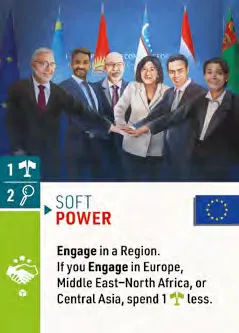
The coloured strip on the card’s side shows its type: green Diplomatic, orange Economic, red Military, blue Domestic. The bonus section at the top left pays out only if the card is still in your hand at Research.
Instead of resolving a card you may do one of these:
Strategic Asset cards
Put an Ability card from your hand face down in front of you (if you have one), resolve one of your face-up Strategic Asset cards, then turn that Strategic Asset face down. Each can be used once per game; their VPs counted only for your starting score, and each one left unused is worth 2 at the end.
Passing
Put an Ability card from your hand face down in front of you (if you have one) and gain
10  .
.
Allied Countries
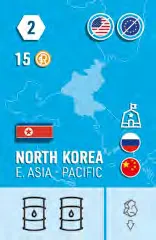
Country cards in front of you are your allies. Each one is either ready (face up) or exhausted (face down). Its parts:
- Value — the number in the hexagon at the top left .
- Invest cost — the money beneath the value.
- Export symbols — the large bottom section: what you can sell.
- Import symbols — the small section with an arrow pointing at you: what you can buy.
- Base symbol
 — the powers whose flags appear beneath it may build a Base there.
 - Crossed-out flags — those powers can never Improve Relations with this Country.
Using a Country for an action (Invest, Build a Base, a discount) exhausts it; you can’t use an exhausted Country. Trade is the exception: it counts symbols on ready and exhausted Countries alike. Countries are readied by your Focus each round and by some cards.
Improve Relations
Diplomatic. Take one of the two face-up Country cards in any Region. Spend  equal
to its value and put it face up in front of you: it is now your ally.
equal
to its value and put it face up in front of you: it is now your ally.
Discount: exhaust other allied Countries from the same Region to lower the cost by their value each.
Each Region always shows 2 Countries: if you take the last card of a pile, move the top card of the other pile into the empty space.
Stacking a starting Country
Every Starting Country has a second copy in the Region decks. If you ally with the copy of a Country you already have:
- put the new card on top of the old one, shifted up so both cards’ trade symbols show, keeping any Base or FDI token;
- if the old card was ready, also add 1 Influence to that Region;
- from now on it is one Country with the top card’s values plus both cards’ trade symbols.
Engage
Diplomatic. Choose a Region where you have at least 1 allied Country. Spend the
cost printed on that Region, add 1 Influence there and put one of your
 Engage tokens on it. If all your tokens are on the board, you may move one instead.
The same discount applies: exhaust allies from that Region to lower the cost by their values. With
Diplomatic Focus, Engage costs 2 less.
Engage tokens pay off later: discard them for money in Return on investments or for Defense in Resolve THREAT. Any number of tokens may share a Region.
Trade
Economic. Your Trade Deals card says how many Export and Import transactions you get (2 or 3 of each). Each transaction is one resource type, and each type can be used only once per Trade: you can’t export the same type twice, import it twice, or export and import it.
Export
Pick a resource type and count its symbols in the large bottom section of your allied Countries, ready or exhausted. Sell up to that many and take the money from the Supply. Armies you export must come from your Player board, never from the map.
Import
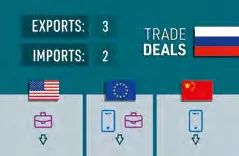
Pick a resource type and count its symbols with an arrow pointing at you: on your allied Countries (the small section) and on your Trade Deals card (one per symbol under another power’s flag). Buy up to that many.
- From Countries: pay the Supply.
- From another player: pay that player. If they have a face-up Commerce card with that resource, they turn it face down; otherwise the resource comes off their board. They can’t refuse. If they have neither, you can’t buy it from them.
- If you bought from at least one player, gain 1 — once per Trade action.
- Russia’s Commerce cards show 3
 or 3
or 3  : you may buy fewer, but you only
gain the Diplomacy if you buy all 3.
: you may buy fewer, but you only
gain the Diplomacy if you buy all 3. - With 2–3 players you can buy from the non-player powers: they always have stock, you pay the Supply and you gain no Diplomacy.
Trade prices
| |  |  |  | ||
|---|---|---|---|---|---|---|
| Export (you earn) | 5 | 5 | 5 | 15 | 15 | 20 |
| Import (you pay) | 3 | 3 | 3 | 10 | 10 | — |
Armies can be exported but never imported.
Invest
Economic. Choose a ready allied Country. Pay the invest cost under its value, exhaust it, put an FDI token on it and add 1 Influence to its Region. You can invest in each Country only once unless a card says otherwise.
Each FDI token pays 2 × the Country’s value every Aftermath.
Move
Military. Move one Army — from your Player board or anywhere on the map — to a Region
in your zone of interest (your small round flag) or a Region where you have a Base. Pay
5 per Army moved.
Build a Base
Military. Choose a ready allied Country with the Base symbol and your flag
beneath it. Exhaust it, put a Military Base token on it, and move Armies from your Player board to
its Region: at least 1, at most the Country’s value. Pay 5 for the Base plus 5 per Army
moved, then add 1 Influence to the Region (just 1, however many Armies went).
With no Army on your board, or not enough money, you can’t build. One Base per Country unless a card says otherwise. The Base stays on the Country card; it lets you Move Armies into that Region from then on.
Get a Growth Card
Domestic. Pay a Growth card’s cost, put it beside your board and gain the VPs on it. Your first Growth card is Level 1; each later one must be exactly one level higher than your last.
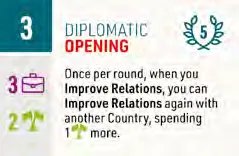
Its ability switches on in the round equal to its level: you can buy a Level 4 card in round 2 and score its VPs now, but its ability waits until round 4. Copies are limited — once a card’s pile is empty, nobody else can take it.
Produce
Domestic. For each resource type a Produce effect lets you choose (any of the 7):
- primary — gain your full production level;
- secondary — produce up to your
level, paying the inputs printed above that track for each one.
When one effect produces several types, they must be different types; you may spend primaries you just produced to pay for secondaries in the same action. Producing a resource shown on your Commerce cards turns them face up again. The storage limit applies.