Learn World Order
Learn the game in 5 short steps. Everything links to the full rules.
Welcome to World Order
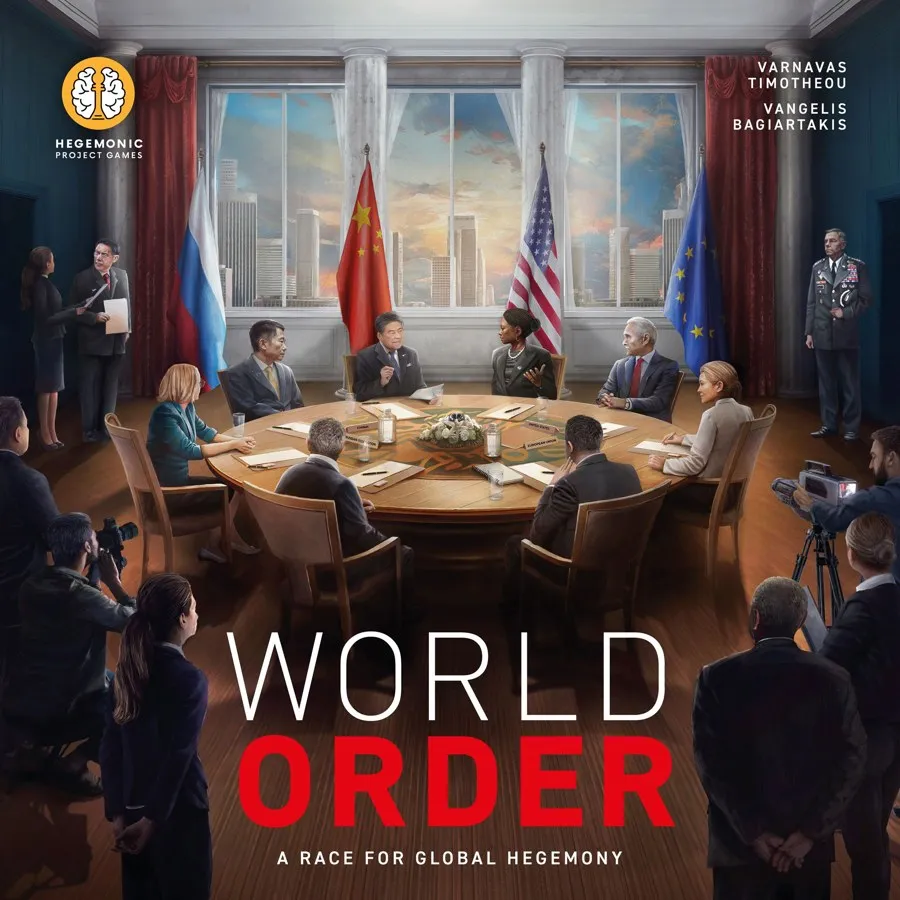
It is 2010 and the balance of power is shifting. Each of you leads one of the four great powers of the decade — the United States, the European Union, Russia or China — and tries to spread your influence across seven Regions of the world through diplomacy, trade and military presence.
The player with the most victory points after 6 rounds wins. Points come from:
- Influence — every cube you place on a numbered slot scores at once, and the Regions where you lead pay a big bonus in rounds 3 and 6.
- Growth cards and Prosperity — investing at home is worth points too.
- Majorities — most money, most Armies on the map and most allied Countries.
Watch out: rivals with more Armies than you in your own backyard cost you points every round.
2–4 players, about 2–3 hours — a first game with four, teach included, often runs longer. Teaching it tonight? See Teach the Game. Ready to set up? Open the setup checklist — it adapts to your player count.
The world map
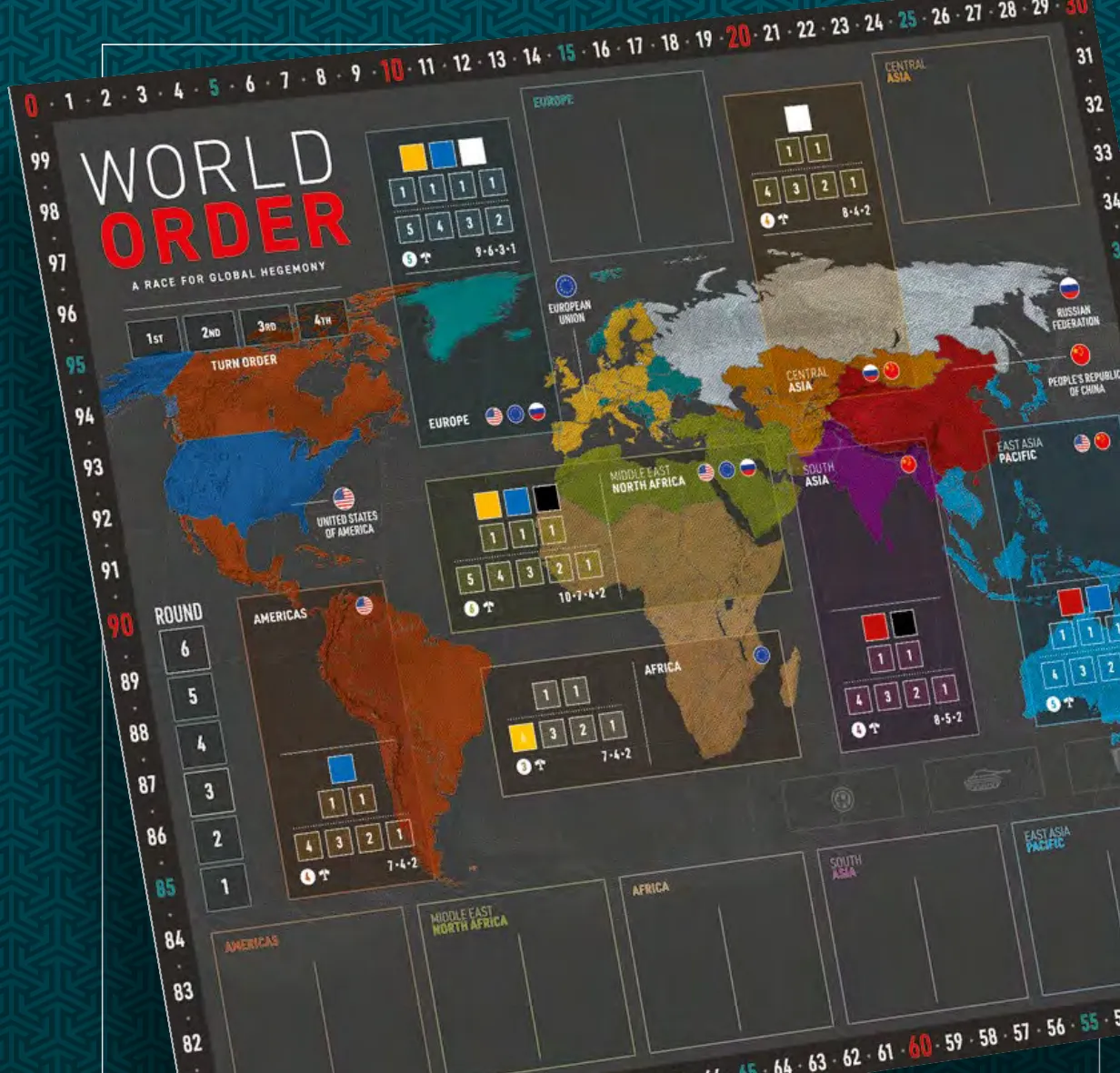
The map has seven Regions. Each Region shows two Country cards you can ally with, the
 Diplomacy cost to Engage there, its Influence slots and its majority bonuses.
Influence slots come in two kinds:
- Permanent (above the line) — the cube stays for the whole game, but scores little now.
- Temporary (below the line) — fill from the left and score more now, but when the row is full a new cube pushes the oldest one out.
A Region scores only if all its permanent slots are filled. Small flags in a Region mark which powers have it in their zone of interest — where rival Armies can hurt them.
More detail: Influence.
A round
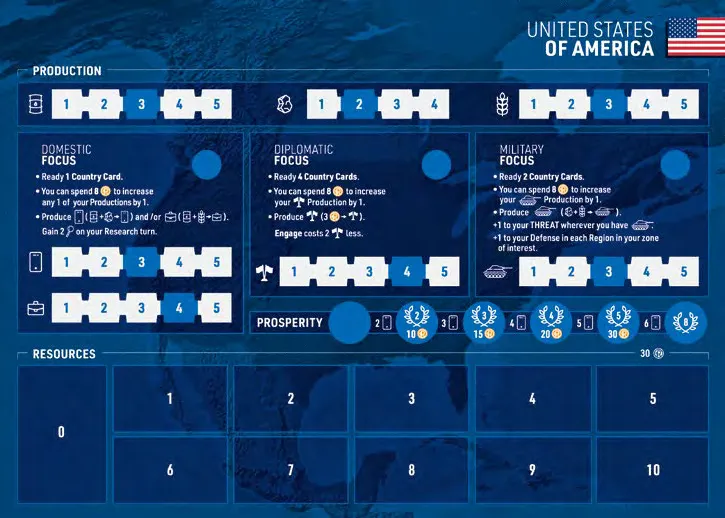
Each of the 6 rounds has three phases.
- Preparation (skipped in round 1) — draw 6 cards, reveal new Countries, pick turn order
(fewest VPs chooses first), produce


 , and choose your
Focus: Domestic, Diplomatic or Military. Your board lists what each Focus lets you do.
, and choose your
Focus: Domestic, Diplomatic or Military. Your board lists what each Focus lets you do. - Actions — everyone takes 4 turns, playing one card each turn. Then the 2 cards left in
your hand pay their bonuses and
 Research, which buys new cards from the Market.
 - Aftermath — collect from investments, raise Prosperity, lose points to rival Armies, and in rounds 3 and 6, score the Regions.
More detail: Gameplay.
Playing cards
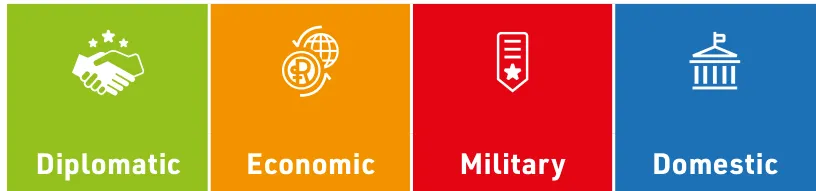
On your turn you play an Ability card and do what it says. Its colour tells you the action type:
- Diplomatic — Improve Relations (spend to ally a Country) and Engage
(add Influence where you have allies).
- Economic — Trade (export and import resources) and Invest (pay to place an FDI token and Influence).
- Military — Move Armies and Build a Base in an allied Country.
- Domestic — Get a Growth Card and Produce resources.
Allied Countries are your engine: exhaust (turn face down) one in a Region to make Diplomacy
costs there cheaper, or to add Research. Instead of a card’s effect you may also play one of your
two Strategic Assets, or pass for 10  .
.
More detail: Actions.
Scoring and the end
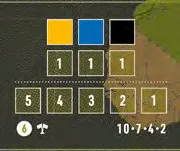
In the Aftermath of rounds 3 and 6, each Region whose permanent slots are all filled scores:
- 1 VP per cube for everyone with Influence there;
- the majority bonuses in the corner for 1st, 2nd and so on — ties go to the player with more Armies there.
Then the three Majority tokens pay for most money, most Armies on the map and most allied Countries. Each power also has its own scoring ability.
After round 6, unused Strategic Assets give 2 VPs each, and the player with the most VPs wins.
More detail: Aftermath & Scoring. Questions at the table? Try the FAQ.