Teach the Game
A table-ready introduction to Yinzi: Ming.
How you win
Develop your merchant family over four rounds. Plant Crops and sell them at Local Markets to recruit Peasants into Workshops; produce Goods, fulfill Silk Road Caravans and export through Ships. At the end, the most Wealth Points (WP) wins. Ties go to the tied player earlier on the Turn Order track.
The boards
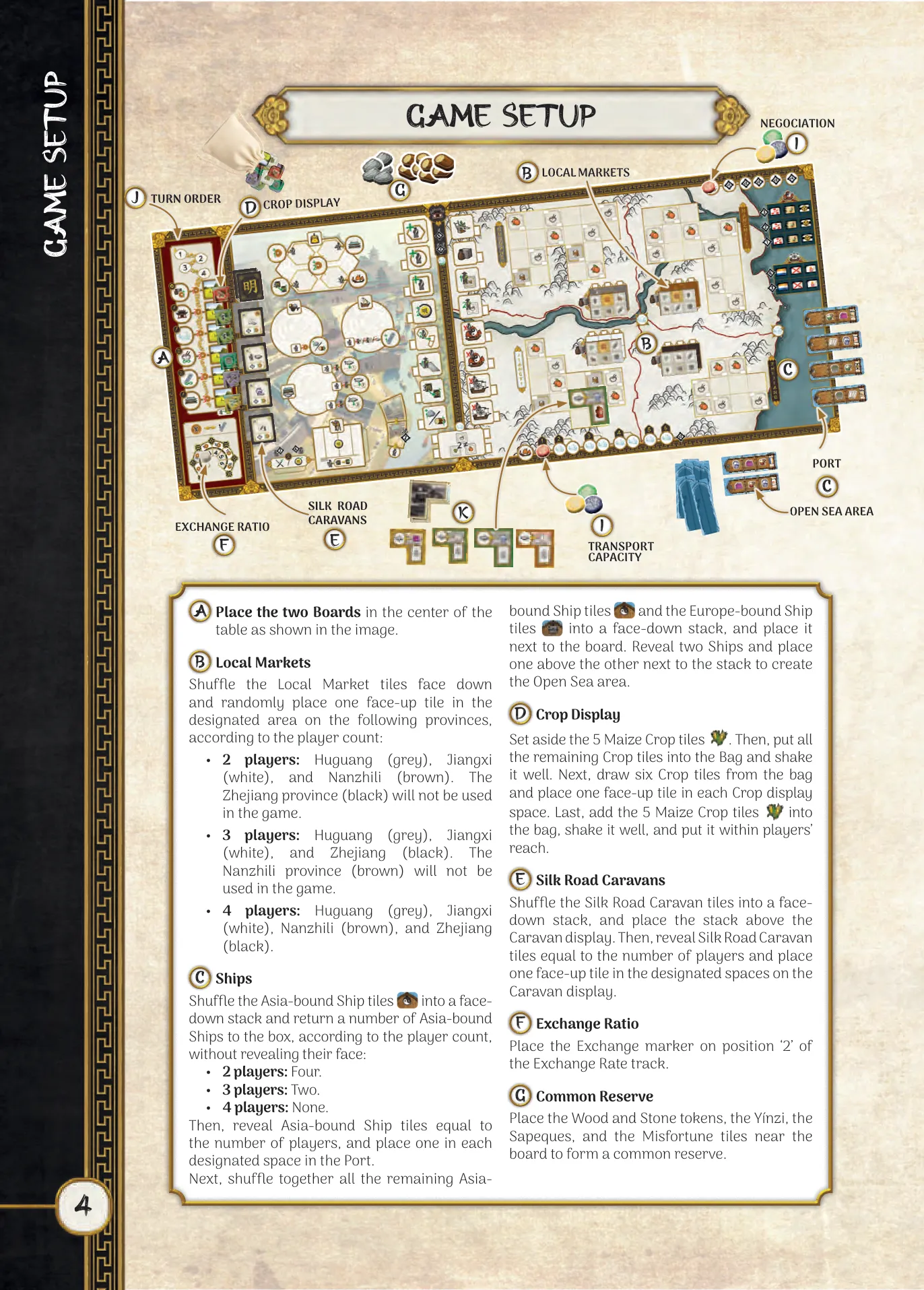
The shared board joins four provinces to Local Markets, the City, Silk Road Caravans and the Port. Your Player board has five Command actions and holds the Order cards you use this round. The color of a Workshop tile sets the Peasant color it needs; the Overseer on it marks its owner.
A round
The game lasts four rounds. Adjust the Sapeque-to-Yínzi exchange rate, choose a Merchant bonus, then take six turns: three Command Directives and three City Directives. Resolve Regulation, then prepare the next round. After round four, resolve any final Caravan and score.
Your turn
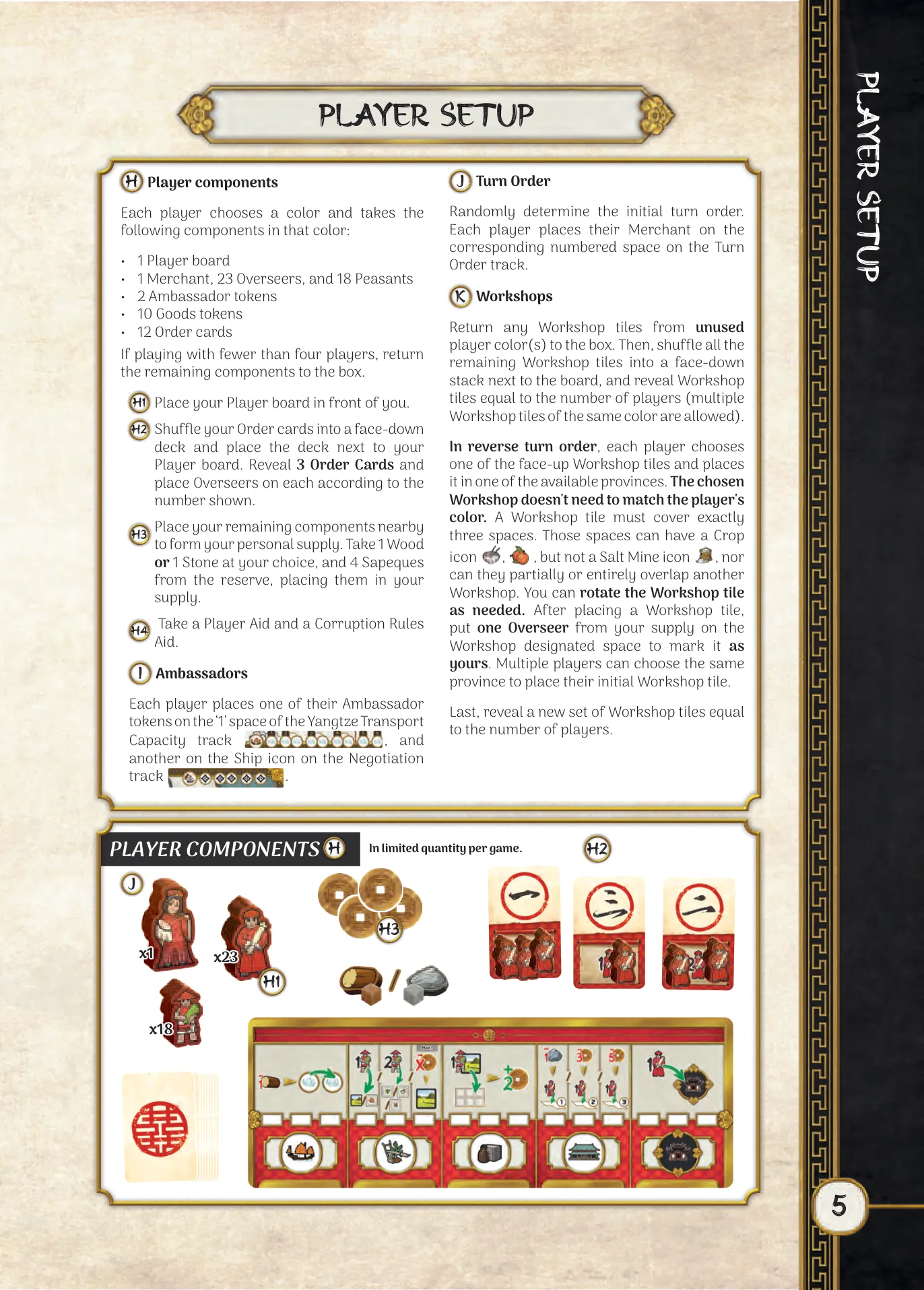
Use a revealed Order card’s top half for a Command Directive, or its bottom half and attached Overseers for a City Directive. Every round you use each personal Command action at most once and each City Quarter at most once. Actions make Peasants, Workshops, Goods, Caravans and exports; each engine depends on moving Peasants and Goods within your Transport Capacity.
How the game ends
After the fourth Regulation phase, fulfill any face-up Caravans in front of you, then score all categories. The game ends after scoring; there is no running WP track.
Ways to score
Score Transport Capacity, Workshops, Goods, foreign exports and Negotiation, Caravan Escort, completed Silk Road Caravans, Corrupt Administration, City Entrance, Yínzi and Misfortune. See Final Scoring.
What each resource is for
Sapeques buy things and exchange for Yínzi; Yínzi pays wages and scores. Wood raises Transport Capacity; Stone builds Workshops. Crop tiles and Peasants create raw goods, while Peasants move through Local Markets into Workshops. Goods are exported or used for Caravans. Overseers power directives and have food and wage costs.
Where to get each thing
| You want | Where it comes from |
|---|---|
| Sapeques | Sell at Local Markets: 2, or 3 at High Demand. Each Imperial Palace request: 2; Palace Maintenance adds 1 more (3 total). Some Caravans. Exchange at the current rate. |
| Yínzi | Each load at the Trade Port: 1. Some Caravans. Exchange at the current rate. |
| Wood and Stone | Materials Market: 1 Sapeque each, one per Overseer. |
| Peasants on Fields | Deploy Peasants. The Crop tile beside your Merchant bonus space comes with 2 Peasants. |
| Goods | Produce in a Workshop at the Artisan Quarter. |
| Workshops | Build for 1 Stone; upgrade for 3 or 5 Sapeques. Build Bridges at the Imperial Palace builds or upgrades one free. |
| Transport Capacity | The Increase Transport Capacity Command. Build an Irrigation Canal at the Imperial Palace. |
| Negotiation | Trade to Asia or Europe when a Ship you loaded sails. |
Teaching tips
Show the peasant chain first: Field → Local Market → Workshop → Ship. Moving between any two Provinces costs 1 capacity per unit; reaching the Port costs 1 or 2 depending on the origin Province, and a Ship cargo departure interrupts the current action. Keep an eye on food and wages before placing more Overseers.
Use the Corrupt Administration benefit reference to distinguish moving an existing Overseer, preparing a destination trade, and gaining an immediate-use resource.