Rounds and Directives
Exchange, bonuses, Command actions, and transport in Yinzi: Ming.
Round sequence
Each of four rounds has five phases: A Exchange Rate, B Bonus and Turn Order, C Directives, D Regulation, and E Maintenance. Follow all Maintenance steps in rounds one through three. During Maintenance in round four, only update turn order before final scoring.
Exchange rate
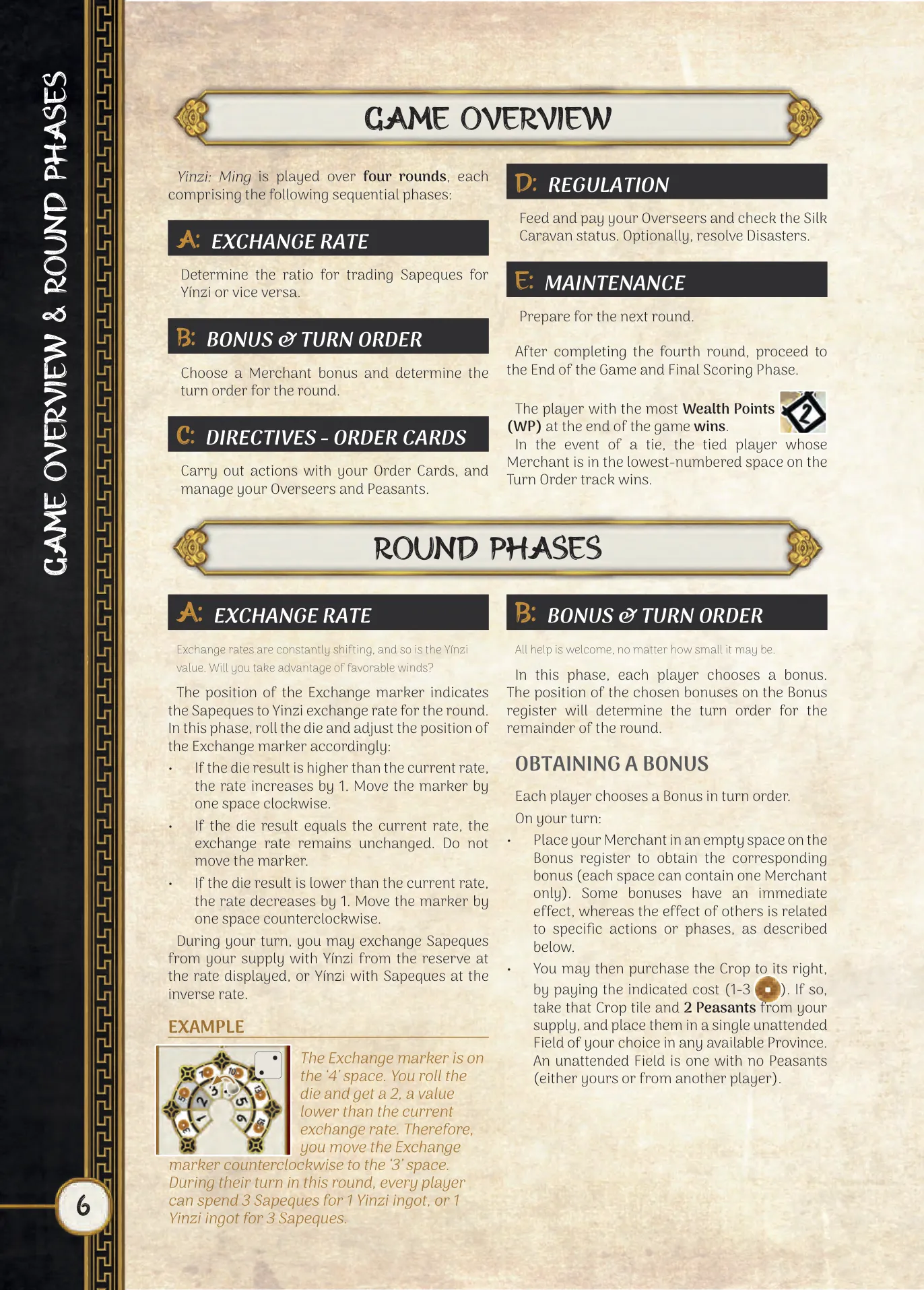
Roll the die. If its result is above the current Exchange marker, move the marker one space clockwise; if below, move it one space counterclockwise; if equal, leave it. During your turn you may exchange Sapeques for Yínzi at the displayed rate or Yínzi for Sapeques at the inverse rate.
Merchant bonus and turn order
In current turn order, place your Merchant on an empty Bonus register space and take its benefit. Each space may hold one Merchant. You may also buy the Crop tile printed beside that space: pay its 1–3 Sapeque cost, take the tile and two Peasants from your supply, and place both on one unattended Field in any available Province. The top-to-bottom Merchant order sets the new turn order for the rest of the round. Refill the register by sliding remaining Crop tiles upward and drawing replacements.
Command Directives
Players take six turns in turn order. Each uses a different half of one of their three revealed Order cards. A Command Directive uses the top half and places that card under one of five personal action spaces. The printed 1–3 lines give that many actions; extra Overseers from your supply can increase the count, up to four total. You may not use the same Command action twice in a round.
The five actions are Increase Transport Capacity, Deploy Peasants, Sell at Local Markets, Build or Upgrade a Workshop, and Corrupt Administration. Resolve one action completely before the next repetition.
Transport capacity
Your Ambassador position on the Yangtze Transport Capacity track is your movement allowance for the current turn. Add the costs for every Peasant or Good moved during that turn; do not move the Ambassador when spending this capacity. The Yangtze connects all Provinces, so moving between any two Provinces costs one point per unit, regardless of adjacency.
| Movement of one Peasant or Good | Transport Capacity used |
|---|---|
| Within one Province | 0 |
| From any Province to any other Province | 1 |
| Huguang (grey) or Jiangxi (white) to the Port | 2 |
| Nanzhili (brown) or Zhejiang (black) to the Port | 1 |
These costs apply when selling Peasants at Local Markets, moving them from Local Markets to Workshops, and supplying Ships. For example, one Good from Huguang and one from Nanzhili to the Port use 3 capacity in total.
Deploy Peasants
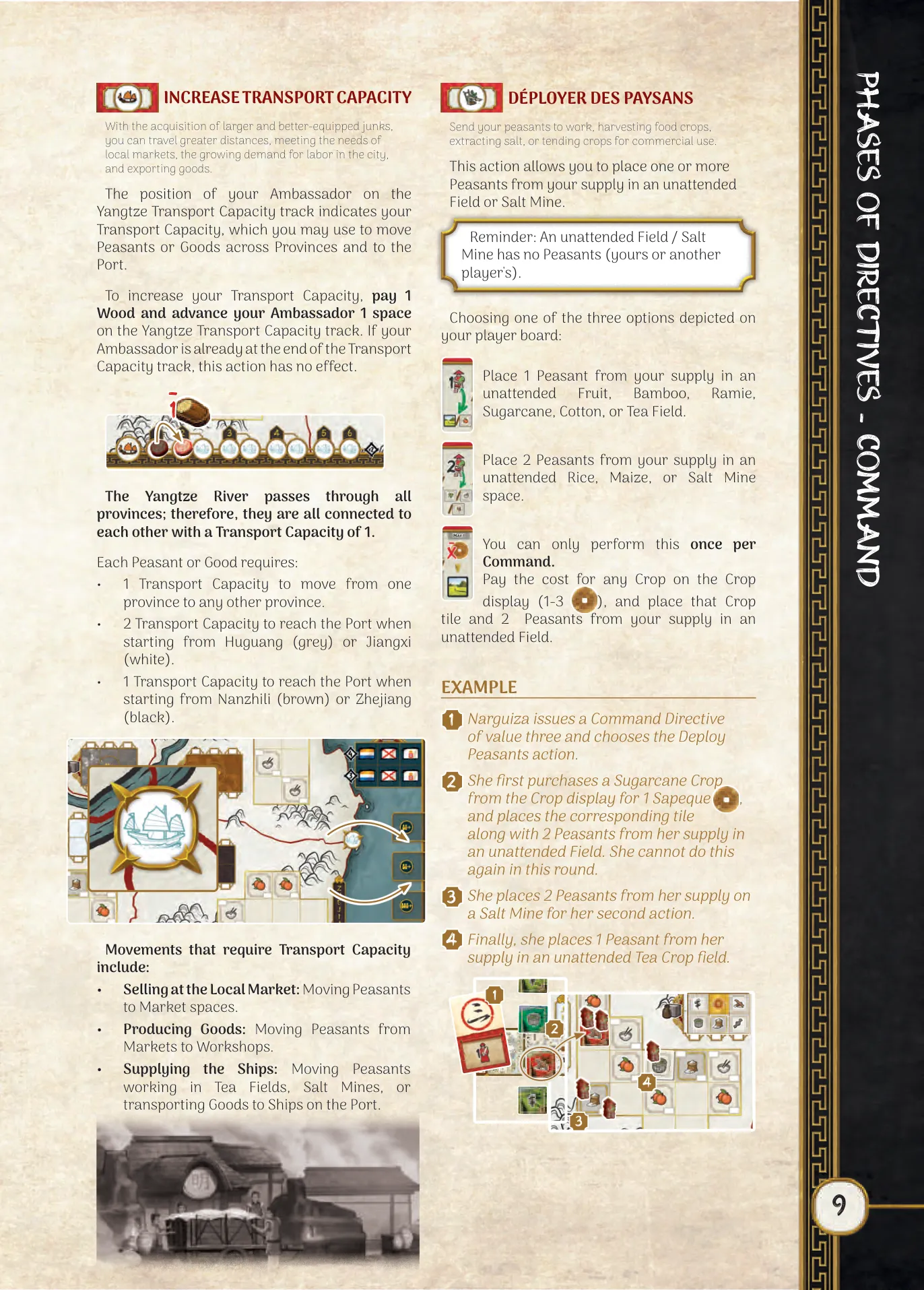
Choose one option each time you resolve this action: place one Peasant on an unattended Fruit, Bamboo, Ramie, Sugarcane, Cotton or Tea Field; place two Peasants on an unattended Rice, Maize or Salt Mine; or pay for a tile in the display and place it with two Peasants on an unattended Field. You can use this last option only once per Command.
Sell at Local Markets
Move a Peasant from a matching Crop Field or Salt Mine to a vacant matching Local Market space. It must satisfy the market’s demand icon and your Transport Capacity. Gain 2 Sapeques, or 3 if the tile shows High Demand for that Crop. A market space already occupied by any Peasant cannot be used.
Workshops and Corrupt Administration
Build by paying one Stone, placing a displayed Workshop over exactly three unattended Field spaces (never a Salt Mine or another Workshop), then marking it with one of your Overseers. To upgrade your Workshop, pay 3 Sapeques for Level II or 5 for Level III and add an Overseer; each upgrade is a separate action. Refill the Workshop display at the end of your turn. Corrupt Administration places one Overseer on an eligible benefit space. Ordinary spaces must be empty; Food Surplus can hold one Overseer of each player, so another player’s Overseer does not block your place there. Its benefit may be used later, but not during the phase in which that Overseer was placed. See the printed benefit reference.