Teach the Game
A table-ready guide to contracts, shared freight trains, Bengal's railways, and end-of-round investments.
How you win
Run a railway company in Bengal for two rounds. Load contract Crates onto any eligible Freight Cars, then move shared trains between Benares and Calcutta. Fulfill Contracts, earn rupees and Profit discs, and invest those discs before each new round. Most victory points after Round 2 wins.
The boards
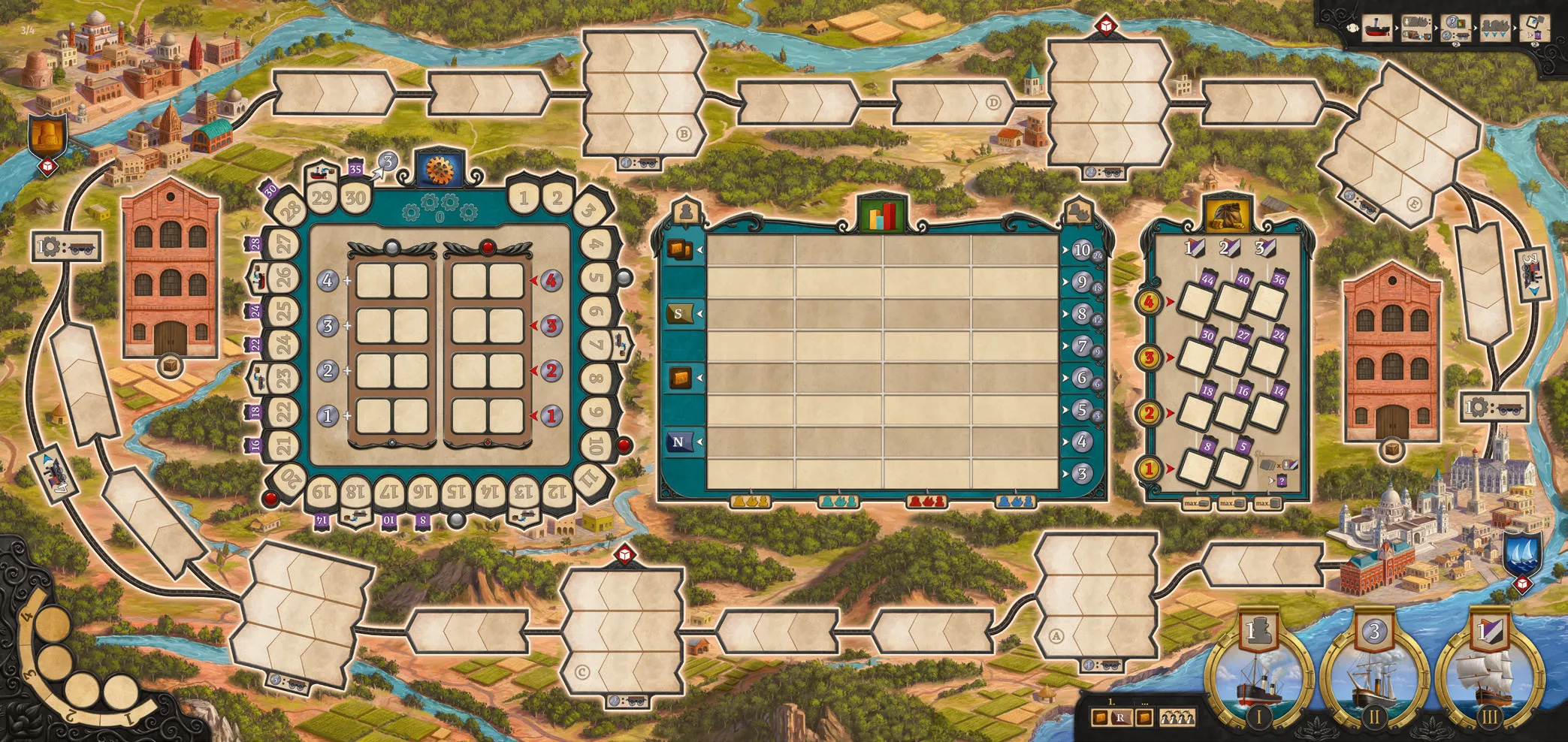
The main board has the railway loop, two cities, three Ship spaces, the shipping rewards, Market and Performance tracks, and the Investment grid. Use the 1–2 player side for solo or two players and the 3–4 player side for three or four players. In a three-player game, cover the printed Investment grid with its replacement.
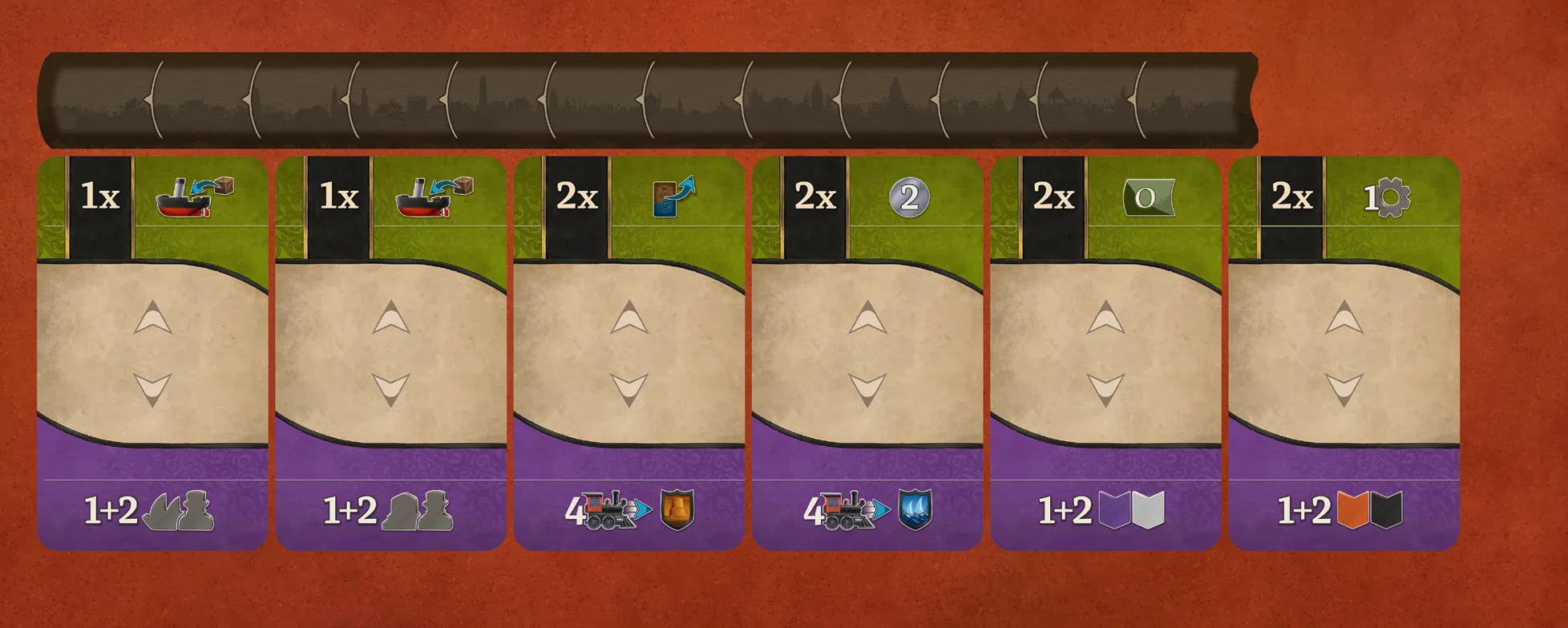
Your Company board holds six action-card spaces, six paired Company actions, your active Contracts, your Goods values, cash, and Trading Posts.
A round
Each of the two rounds has two phases:
- Action phase: In turn order, each player plays one card into one of six spaces on their Company board. Choose which half of the Company action remains visible. Resolve the card action and that Company action, in either order. Repeat until every player has filled all six spaces.
- Administration phase: Reorder players by Crates shipped, award Transaction tokens and a Regional Trading Post, penalize Crates still in transit, pay for deliveries, align Market pawns, then invest Profit discs. At the end of Round 1, clear cards, return delivered and shipped Crates to their owners, and draft three Load and three Move cards for Round 2.
How the game ends
After the second Administration phase, score five categories: Goods, Transactions, Performance, Investments, and the investor bonus. For Goods, multiply each type you own by its track value. Your completed Contracts, starting Goods token, and purchased red Performance tiles can add Goods.
Ways to score
| Source | How it scores |
|---|---|
| Goods | Each Goods marker’s value times the number of that Good you own. |
| Transactions | Transaction tokens times the combined end-game values of your Trading Posts. |
| Performance | The printed points at the furthest space reached on the Performance track. |
| Investments | Points printed above each of your Investment markers. |
| Investor bonus | Each Investment marker also scores your lowest Goods value. |
What each resource is for
| Resource | Use |
|---|---|
| Rupees (₹) | Pay action costs and collect delivery income. When the Treasury marker passes 9, gain a Profit disc and reset it to 0. |
| Profit discs | Spend during Administration to place Investments. |
| Goods | Four types: Precious Goods, Bonds, Resources, and Infrastructure. Their values multiply your end-game Goods count. |
| Crates | Fulfill Contracts, travel in Freight Cars, and ship for turn-order rewards. |
| Transaction tokens | Multiply the value of your Trading Posts at game end. |
| Freight Cars | Carry Crates on a shared railway. The owner gets delivery income and Performance when their car reaches a city. |
| Market pawns | Benares and Calcutta pawns set delivery values; the Financial Advisor earns immediate benefits at marked spaces. |
Where to get each thing
| You want | Where it comes from |
|---|---|
| Rupees (₹) | Delivery income in Administration: delivered Crates times that city’s Market value. The row bonus after the Market adjustment. Some Shipping rewards and Trading Post effects. ₹3 if you skip a whole turn. |
| Profit discs | One each time your Treasury marker passes 9, and one per complete ₹10 of delivery income. |
| Goods values | Goods Value actions on cards and your Company board and Investments paid with Profit discs. |
| Trading Posts | Create them with actions; the new first player also gains a Regional Post. |
| Transaction tokens | Shipping priority: one for the new first player and one for each other player with a Crate on a Ship. |
| Contracts | Complete one, then draw two of the same type and keep one. Contracts. |
Teaching tips
- Explain that Freight Cars and trains are shared: any player can move any eligible train, but each car keeps its owner and Crates.
- Demonstrate a junction before the first move. A train can split there; cars in a row cannot have gaps.
- Show the shipping rewards before the first Action phase. Shipping affects next round’s turn order and gives Transaction tokens.
For optional modules, use the Master Print component reference to distinguish Ship rewards from white Performance effects and explain the Fare/Leader abilities.