Britannia
The Britannia map adds regional permissions, maritime routes and regional scoring.
Short tag: [Britannia]
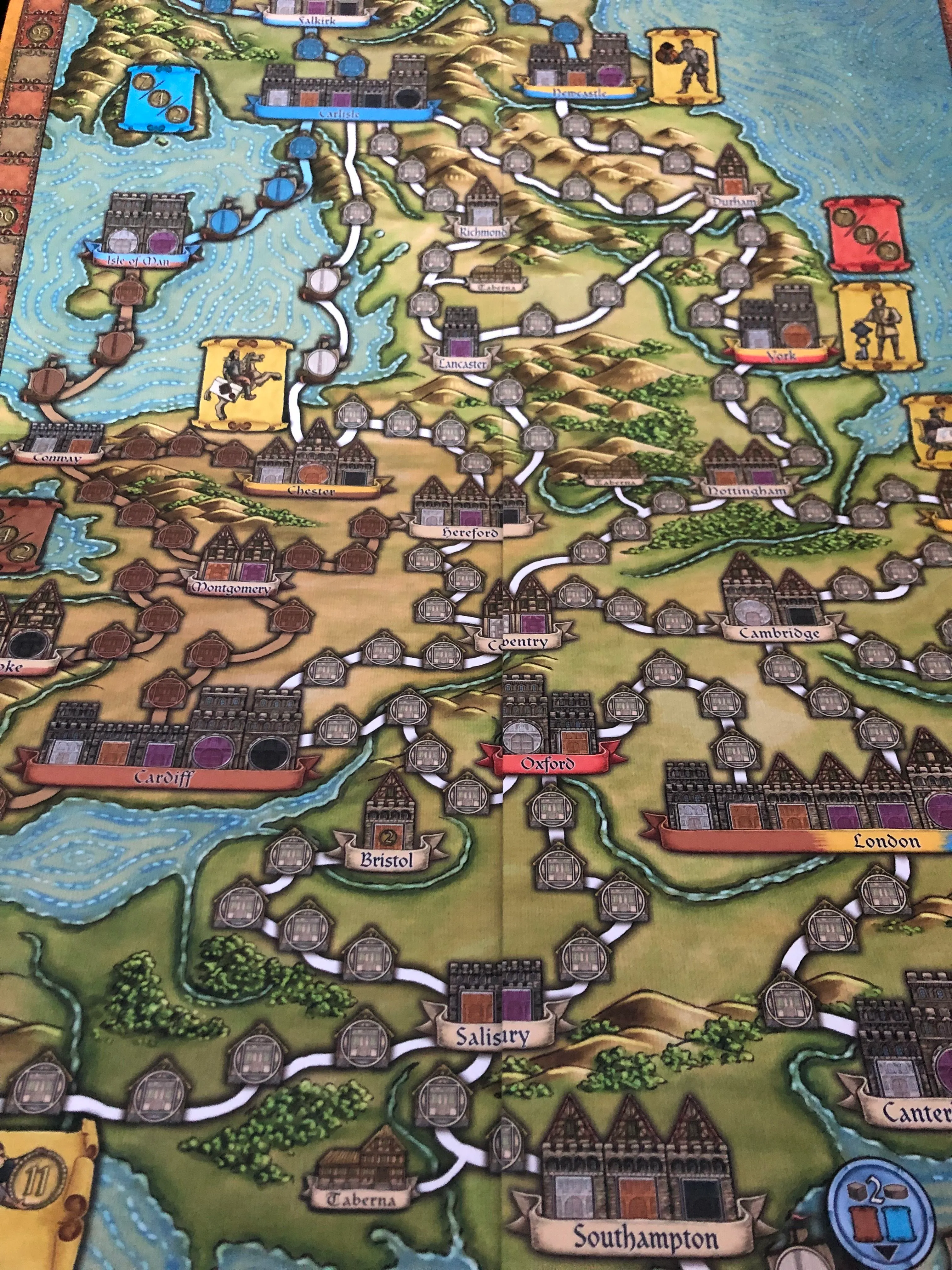
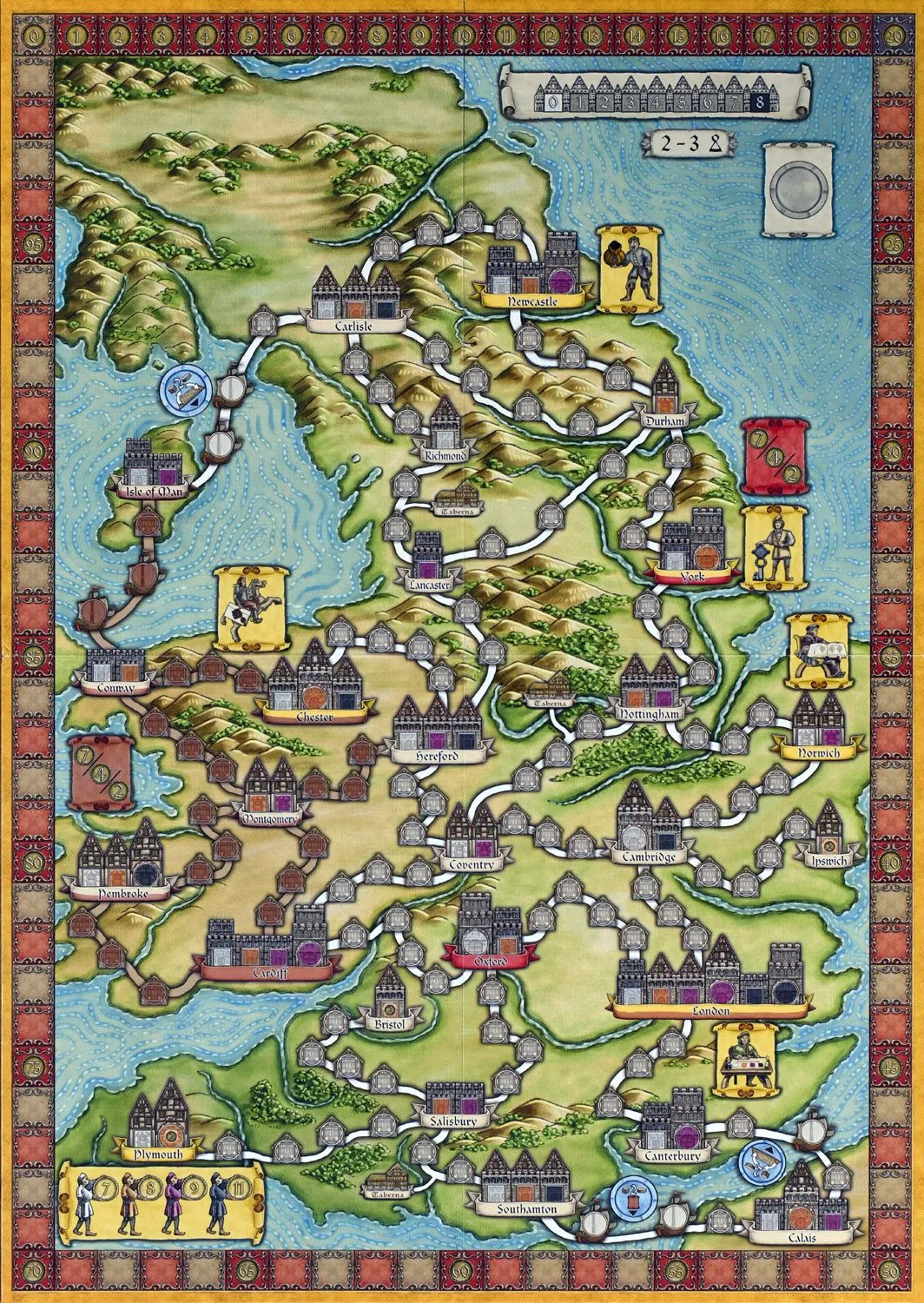
What it adds
[Britannia] The 3-player side covers England and Wales. The 4–5-player side adds Scotland. Routes at sea require merchants and use printed permanent effects. The standard setup otherwise applies.
Setup changes
[Britannia] Choose the side for the player count. Use the ordinary player pieces, writing desks, bonus markers and start setup. Put the three starting markers on Richmond–Lancaster, Coventry–Nottingham and Salisbury–Southampton. The variant ends when the eighth city is completed, rather than the tenth.
Permissions and regions
[Britannia] Resources may be placed or displaced into Wales only if you have the rightmost office in Cardiff or London. On the 4–5 player side, you may place or displace into Scotland if you have the rightmost office in Carlisle or London. Each office grants one regional activity per turn; permissions add, so Cardiff and London together allow two activities in Wales. Ordinary activities may still be used in England.
[Britannia] There is no special permission needed to establish a route in Wales or Scotland, or to move a resource already in a region. A resource in Wales may move within Wales or into England, but not Scotland; a resource in England may move within England, but not into either region. A resource in Scotland may move within Scotland or England, but not Wales. Bonus markers cannot move pieces out of Scotland or Wales. When displaced from a white route, recovery pieces cannot be placed onto adjacent red or blue routes; from Wales, recovery may use red or white routes but not blue, and from Scotland it may use blue or white but not red.
[Britannia] Sea-route spaces are merchant-only. Permanent bonus markers printed on the map are acquired like ordinary markers, used immediately, do not score prestige, and remain on that route. Ordinary markers cannot be placed in Wales or Scotland or on a route with a permanent marker. The “Remove three Traders” marker instead replaces three resources. Oxford–York is the Kontor network for the map; Plymouth replaces Coellen for special scoring. At game end, the first/second/third player in Wales scores 7/4/2 points; use the same scoring for Scotland on the 4–5 player side. Control is by most offices, with rightmost office breaking a tie; if tied for most cities, compare the total offices in the region, and split tied rank awards evenly, rounding down. Isle of Man counts in both regions on the larger side.
Optional border permission
[Britannia] If using this optional rule, discard one unused ordinary bonus marker to gain permission to place, displace and move pieces on routes of any color for the rest of your turn. Remove the paid marker from the game; it gives no end-game marker points. This permission does not cover extra actions granted by +3 or +4 Actions bonus markers. Merchant-only sea spaces still require merchants.
See the publisher’s German Britannia rules sheet, page 4.
Britannia marker effects
[Britannia] These effects use both traders (cubes) and merchants (discs), collectively called resources. Resolve a permanent printed marker immediately when claiming its route; it stays on the board and never counts toward marker scoring.
| Marker | Effect |
|---|---|
| Replace three Resources | The ordinary Move 3 marker changes on this map: relocate opponents’ resources one at a time to empty route spaces within the same country. It cannot move a piece across a border. |
| Replace two Resources (permanent) | Relocate any two resources, including your own, within their respective countries. You may swap their positions. |
| Place two Resources (permanent) | Take two resources from your general stock (from personal supply only if that stock is empty) and place them on empty route spaces in Wales or Scotland (Wales only on the smaller side). |
The other markers retain their base effects.
Two-player variant
[Britannia] The official two-player variant adds a neutral player and can use the base, East, or Britannia map. At setup, place one neutral trader on every route touching a yellow special-action city (Newcastle, Chester, York, Norwich, London, Plymouth and Cardiff), then on each of the three start-marker routes. Put the neutral score cube at 0. The neutral player cannot win, but its score can trigger the 20-point end.
[Britannia] Setup step: After normal map setup, seed the neutral traders and score cube as described above. Refill neutral marker routes at the end of the active player’s turn alongside that player’s markers.
[Britannia] When a neutral trader is displaced, the other human player moves it and one additional neutral trader to an adjacent legal route, following ordinary displacement restrictions. Unlike your own displaced pieces, a neutral piece displaced in Wales cannot recover into England. A route filled with neutral traders resolves immediately during the active player’s turn: place a neutral office in the next available city space regardless of privilege or shape, pay the usual prestige points, and remove the other route traders. If that route touches a special-action city, leave one neutral trader on it. The neutral player uses only traders (including on sea routes). If it acquires a bonus marker, discard it without activating it.
[Britannia] At the end of each player’s turn, refill both the player’s and neutral player’s marker routes. Put a neutral trader on every route receiving a new marker. If no empty route is available, use a route with one neutral trader and do not add a second; an endpoint city must still have an available office. If the neutral supply runs out, use cubes of another neutral color. The neutral player can control cities, preventing the lower-ranked human from scoring that city’s two points; it also takes part in the Wales and network scoring, but it can never win.
See the publisher’s Britannia rules sheet, pages 1–4.
End and scoring changes
[Britannia] The eighth completed city is the map-specific end trigger. Score the usual prestige track, abilities, markers, city control and network, then the regional awards above. Use the current corrected Britannia board; it resolves a mislabeled connection in an earlier printing.
Regional awards
Rank players by cities controlled in the region, then by their total offices in that region. City control uses most offices, with the rightmost office breaking a tie. Players controlling no cities can still rank by their offices; players with no offices in the region receive no regional award.
| Rank | Prestige points |
|---|---|
| First | 7 |
| Second | 4 |
| Third | 2 |
For a remaining tie, add the awards for the occupied ranks, divide equally and round down. The next player takes the next unoccupied rank. Score Scotland separately on the larger map; Isle of Man counts in both regions.