Teach the Game
A script to teach Azul at the table — how you win, the player board, a round, the end, every way to score and what each piece is for.
How you win
“We are tile artists decorating the walls of the Royal Palace of Évora. In 30 to 45 minutes we take turns drafting coloured tiles from the factories, line them up on our boards and set them into our walls. Whoever has the most points when someone finishes a full row of their wall wins.”
What you need, and how you get it:
- Tiles on your wall, next to each other — a tile scores more the more tiles it touches in its row and column, so you build connected blocks instead of scattered tiles.
- Few broken tiles — every tile you take but can’t use falls on your floor line and costs points.
The loop: take all tiles of one colour → fill a pattern line → at round end, move one tile of each full line to your wall and score it.
The boards
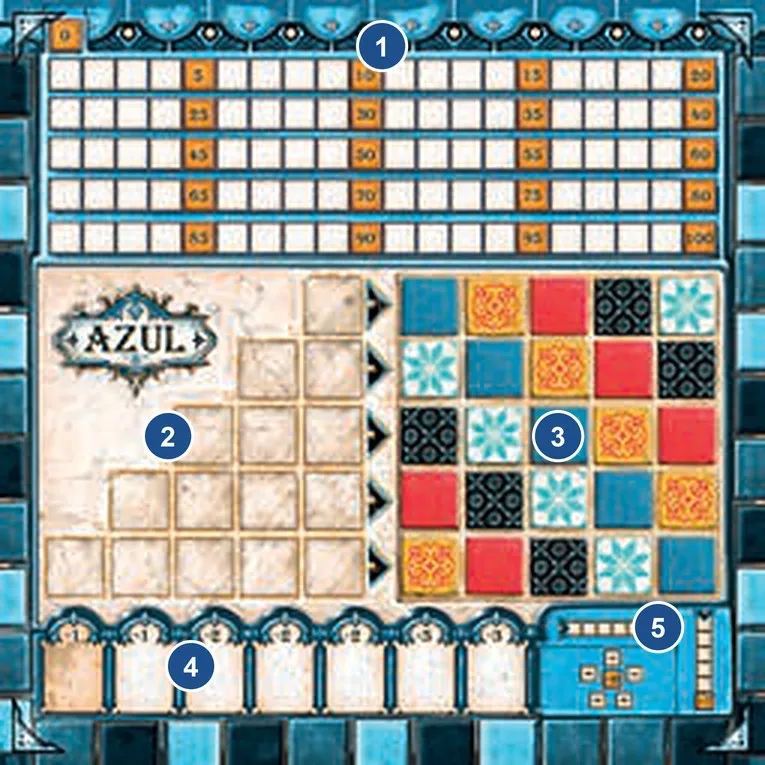
- Score track — 0 to 100; your marker starts on 0.
- Pattern lines — 5 lines of 1 to 5 spaces where you collect tiles.
- Wall — 5 × 5 spaces, one space per colour in each row and column.
- Floor line — 7 spaces, from −1 to −3 points each.
- End-of-game reminder — row +2, column +7, colour +10.
In the middle of the table: the Factory displays (5 / 7 / 9 for 2 / 3 / 4 players), each with 4
tiles, and the center of the table, which starts empty except for the  starting
player marker.
A round
- Factory offer — in turn, take every tile of one colour from one
factory (the rest go to the center) or every tile of one colour from the center. The first
player to take from the center also takes the marker onto their floor line.
- Put the tiles on one pattern line, right to left; leftovers fall on the floor line.
- When factories and center are empty, Wall-tiling: each full pattern line moves its rightmost tile to the wall and scores; the rest of that line goes to the box lid. Then lose points for your floor line.
- Prepare the next round — whoever holds the starting player marker refills the factories and starts.
How the game ends
The game ends after the Wall-tiling of the round in which someone completes a horizontal row of 5 wall tiles. Then add the final bonuses. Most points wins; a tie goes to the player with more complete rows, otherwise the win is shared.
Ways to score
| Source | How | When |
|---|---|---|
| A tile placed on the wall | 1 point alone; otherwise count the tiles linked in its row and in its column (each including itself) | Wall-tiling, every round |
| Floor line | −1, −1, −2, −2, −2, −3, −3 for spaces 1–7 (never below 0) | End of every Wall-tiling |
| Complete row | +2 each | Game end |
| Complete column | +7 each | Game end |
| All 5 tiles of one colour on the wall | +10 each colour | Game end |
What each resource is for
| Piece | Why you need it | How you get it | How you use it |
|---|---|---|---|
Tiles      | They are your points | Factory offer: all of one colour from a factory or the center | Fill a pattern line, then one moves to your wall |
| Pattern lines | They decide which tiles reach the wall | Every board has 5 | Complete a line in a round to tile it; an unfinished line waits for the next round |
| Starting player marker | First pick next round | First to take tiles from the center | Costs one floor space (−1 or more) this round |
| Floor line | Holds what you can’t use | Overflow, the marker, or by choice | Lose points at the end of the round, then empty it |
Teaching tips
- Show the scoring with two or three tiles on a board before anyone plays: adjacency is the whole game.
- Stress that you must take every tile of the chosen colour — that is how other players force you to break tiles.
- Point at the floor line early: −1 and −2 add up fast, and late in a round you may have no good choice left.
- Remind players that a pattern line can’t take a colour already in that wall row.