Cards & Components
Boards, cards, tiles, tokens, and symbols used in 1930.
Boards
- Game board: double-sided for 2–3 and 4–6 players; includes the map, income, technology, phase, and turn tracks.
- Additional Destination boards: two double-sided boards, selected by player count.
- Stock Market board: tracks the market value of each airline and holds the available stock pool.
- Player boards: track each player’s owned shares and those already used for operating actions.
Cards
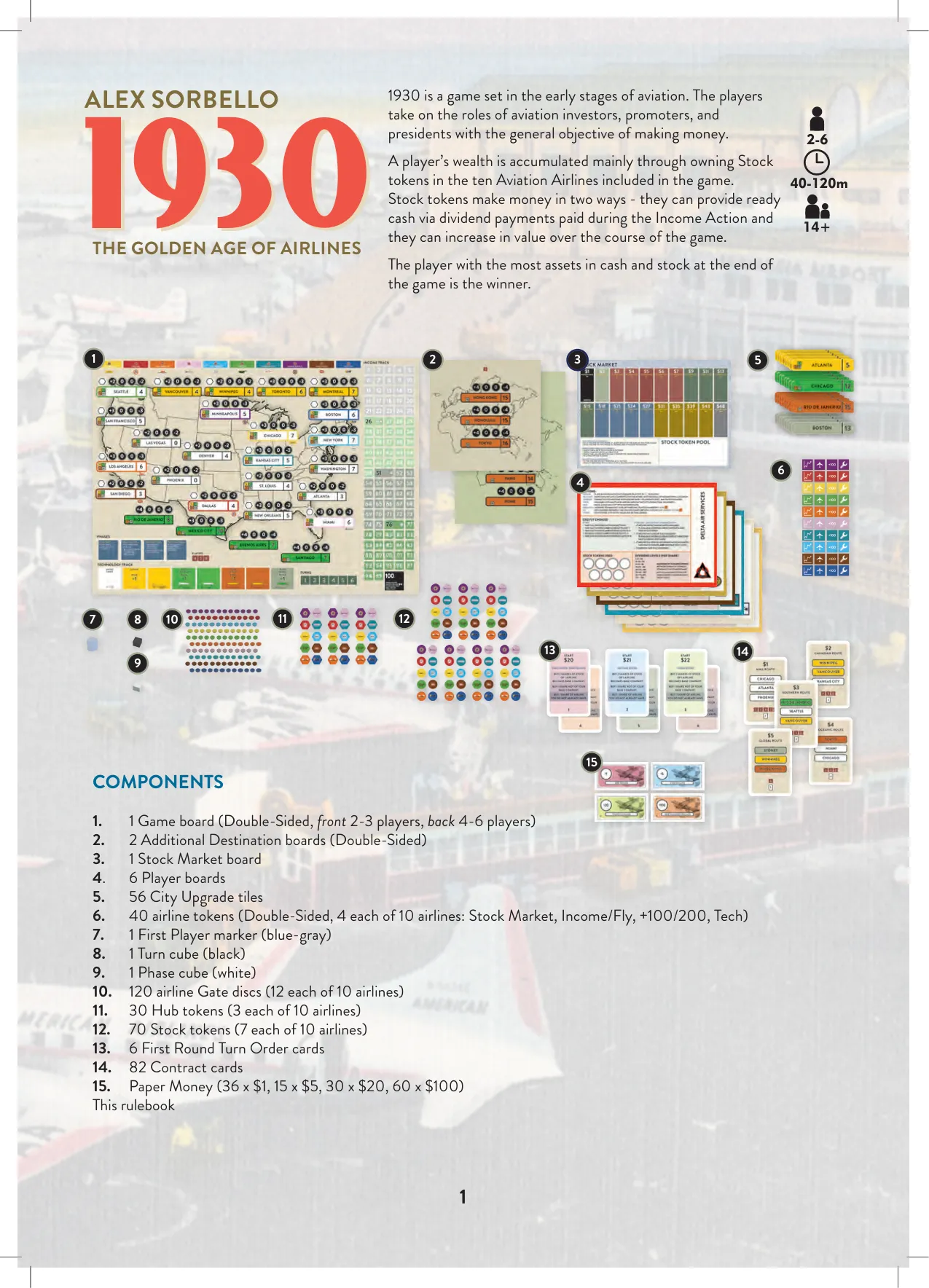
- First Round Turn Order cards: set the first stock-round order and each player’s starting cash.
- Contract cards: 82 cards in five value decks. Each player receives one from each deck; only selected printed examples are referenced below, and the full set of faces remains unaudited.
One printed Contract example (p. 5)
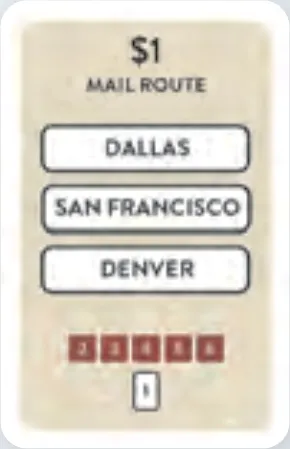
The pictured $1 Mail Route card names Dallas, San Francisco, and Denver. The small lower symbols remain unreadable in this printed example, so their meaning is not transcribed here.
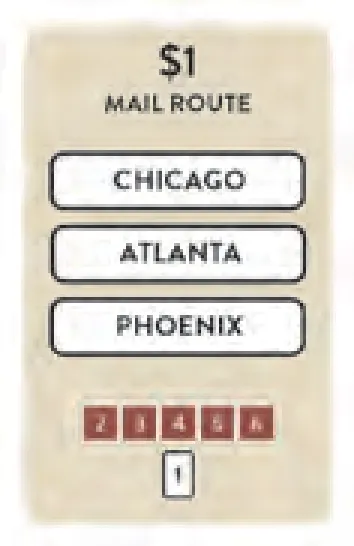
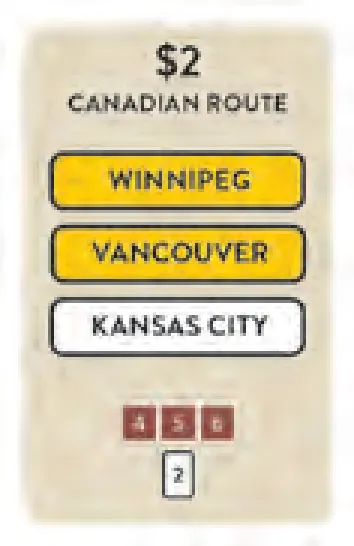
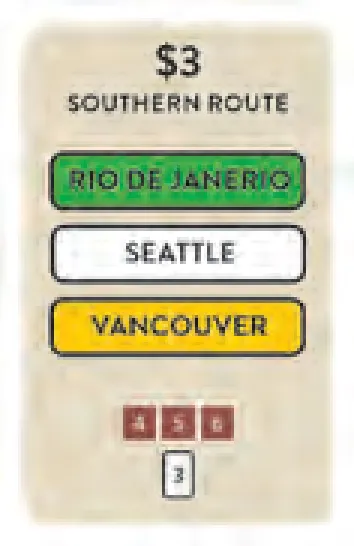
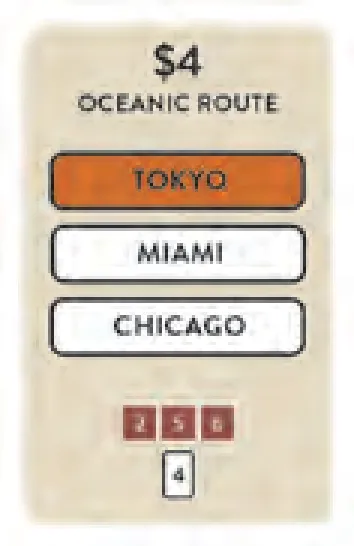
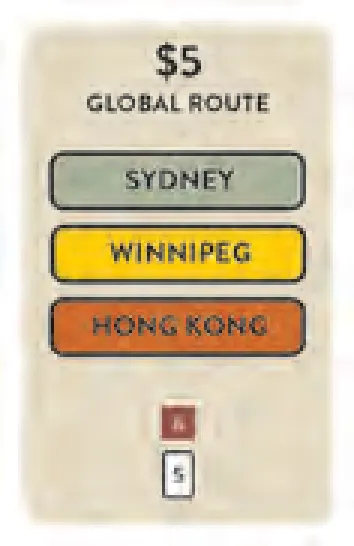
Five printed Contract examples (p. 2)
| Value and printed title | Cities listed on the card |
|---|---|
| $1 Mail Route | Chicago, Atlanta, and Phoenix |
| $2 Canadian Route | Winnipeg, Vancouver, and Kansas City |
| $3 Southern Route | Rio de Janeiro, Seattle, and Vancouver |
| $4 Oceanic Route | Tokyo, Miami, and Chicago |
| $5 Global Route | Sydney, Winnipeg, and Hong Kong |
The setup figure partly covers the lower-row $4 and $5 cards, but the hash-pinned PDF embeds all five card images separately. The lower markings and small player numbers are not interpreted here. These examples do not close the full set of 82 Contract faces, which remains unaudited.
Tiles
- City Upgrade tiles: raise a city’s printed income and technology color. The example below shows Chicago upgraded from White to Yellow and the resulting income changes for airlines there. This is one printed example, not the full set of 56 City Upgrade tile faces.
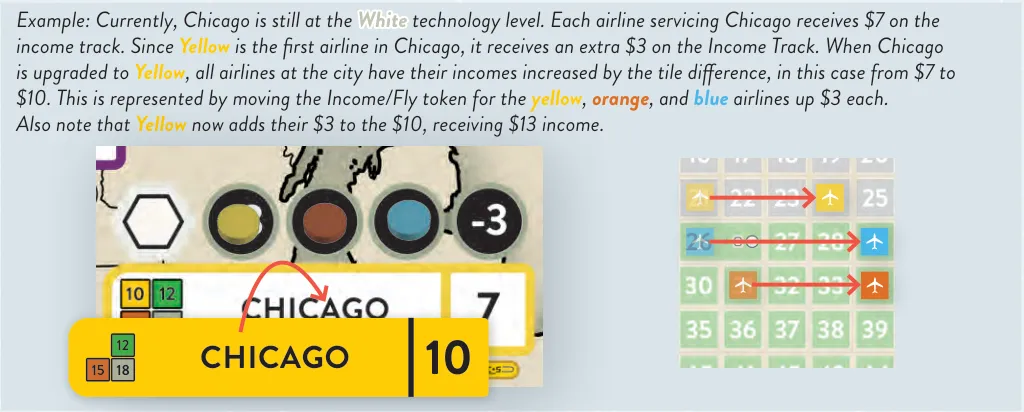
Examples printed on p. 4 (not the complete set)
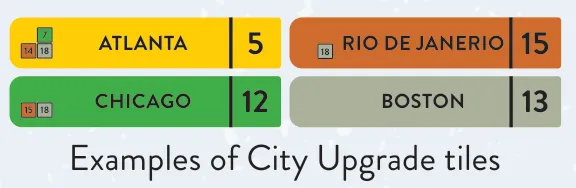
| City | Tile color | Printed income |
|---|---|---|
| Atlanta | Yellow | 5 |
| Rio de Janeiro | Brown | 15 |
| Chicago | Green | 12 |
| Boston | Gray | 13 |
Tokens & pieces
- Airline tokens: track stock market position, income and flight status, technology, and the +100/200 income thresholds.
- Gate discs: show each airline’s presence in a city.
- Hub tokens: add income at eligible cities.
- Stock tokens: represent airline shares and can be used to take operating actions.
- Turn and Phase markers: track the game sequence.
- Money: paper currency in $1, $5, $20, and $100 denominations.
- First Player marker: identifies the current first player.
Airline token faces and reminders
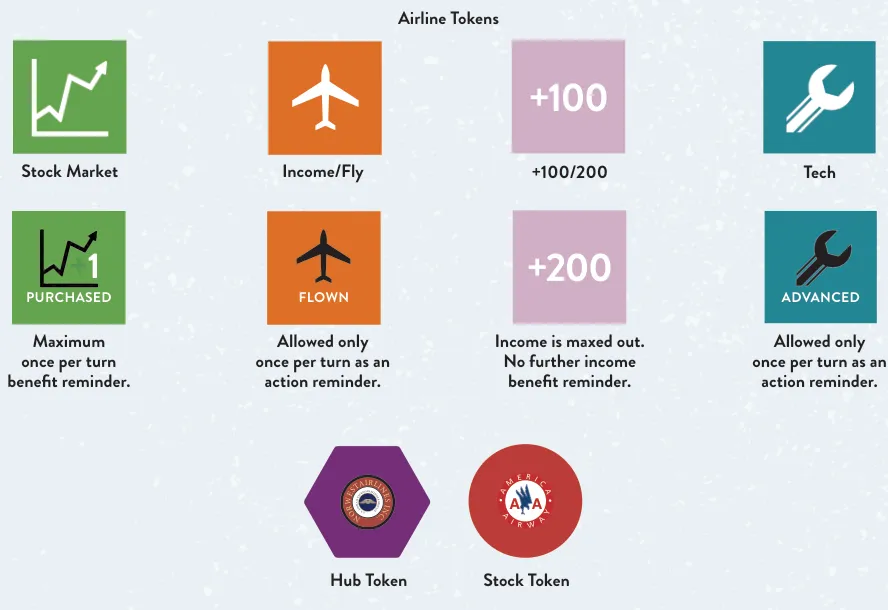
| Token | Printed side or values | Printed reminder |
|---|---|---|
| Stock Market | Purchased | Maximum once per turn benefit reminder. |
| Income/Fly | Flown | Allowed only once per turn as an action reminder. |
| +100/200 | +100 / +200 | Income is maxed out; no further income benefit reminder. |
| Tech | Advanced | Allowed only once per turn as an action reminder. |
| Hub Token | One illustrated token | Named in the printed key. |
| Stock Token | One illustrated token | Named in the printed key. |
Icons
The p. 16 key above shows the Airline Token symbols and reminder sides. The same page’s Seattle inset explains one city’s Gate-position modifiers and printed City Upgrade values:
Seattle map example (p. 16)
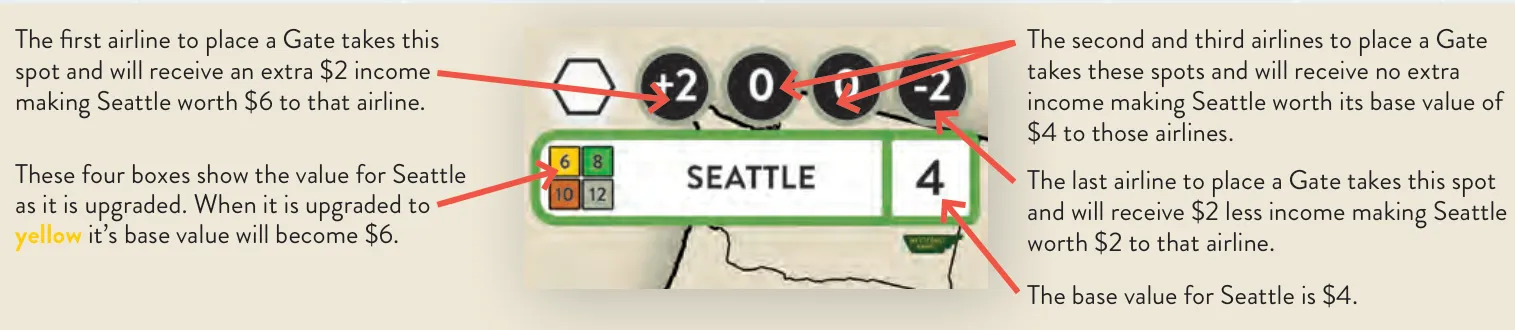
| Seattle example | Printed income |
|---|---|
| Base city value | $4 |
| First Gate position | +$2, for $6 |
| Second and third Gate positions | $0, for $4 |
| Last Gate position | −$2, for $2 |
The inset also shows Seattle’s City Upgrade values: Yellow $6, Green $8, Brown $10, and Gray $12. These are values from the Seattle example only, not a complete map-symbol or city-value reference.